Author: Sebastian Strobl

  • Simplify to Thrive: A Busy Dad’s Guide to Minimalism

    Simplify to Thrive: A Busy Dad’s Guide to Minimalism

    Picture this: It’s a Monday evening. You’ve just wrapped up a demanding day at work, racing against deadlines and managing a barrage of emails. As you pull into the driveway, you’re already switching gears to help your kids with their homework. A quick glance at the clock reminds you that soccer practice starts in 20 minutes. Dinner still needs prepping, your parents called earlier with something they need help with, and you promised your spouse some quality time after the kids go to bed. Amidst all this, where’s the space for you?

    As a dad juggling a demanding career, family life, and personal health, it can feel like you’re sprinting on a never-ending treadmill. But what if there’s a way to step off, breathe, and bring order to the chaos? That’s where minimalism comes in—not just as a way of owning fewer things but as a mindset to help you focus on what truly matters.

    In this article, I’ll walk you through how minimalism can transform your life as a busy dad, sharing practical tips and personal insights along the way.


    The Modern Dad’s Dilemma

    Let’s start with the reality of the modern dad’s life. You wear countless hats—employee, husband, father, son, coach, and maybe even mentor. Each role comes with its own set of demands.

    At work, you’re expected to deliver results, often in a high-pressure environment where “being available” extends well beyond 9-to-5. I remember the time I had to take a client call during my daughter’s school recital. I’ll never forget the look of disappointment on her face as I stepped out.

    At home, you’re managing everything from homework help to chauffeuring kids to soccer and dance classes. Weekends? Forget about relaxing—they’re filled with birthday parties, home repairs, and grocery runs. And let’s not even get started on trying to fit in a workout or prepping a healthy meal for yourself.

    Adding to this, many of us are part of the “sandwich generation,” supporting aging parents while raising young children. And in the middle of it all, there’s your marriage, the foundation of your family, which also needs nurturing.

    It’s no wonder so many of us feel overwhelmed, burnt out, and constantly behind.


    What is Minimalism for a Busy Dad?

    When most people hear “minimalism,” they think of bare walls and owning just 30 items of clothing. But minimalism isn’t about deprivation; it’s about focus.

    For a busy dad, minimalism is the practice of cutting out the non-essential—whether it’s clutter, commitments, or distractions—to create space for what matters most. It’s about spending time and energy intentionally, instead of spreading yourself too thin.

    When I first started embracing minimalism, it wasn’t about throwing out half my stuff. It began with asking myself one simple question: “What do I truly value?” For me, the answers were clear—my family, my health, and meaningful work. Everything else? It could wait.


    The Key Pillars of Minimalism for a Busy Dad
    1. Prioritization

    Minimalism starts with identifying what matters most to you. For me, this meant making family dinners non-negotiable, scheduling regular workouts, and setting boundaries at work.

    One trick I use is the “big rocks” method. Imagine your day as a jar. The big rocks are your priorities—family, health, work. The pebbles are less important tasks, and the sand is the fluff. If you fill your jar with sand first, there’s no room for the big rocks. But if you start with the big rocks, everything else can fit around them.

    2. Streamlining

    Life is full of small decisions that drain your energy. Streamlining means automating or simplifying these as much as possible.

    • Meal Prepping: Every Sunday, my wife and I spend an hour planning and prepping meals for the week. It’s not just efficient—it’s a great way to bond.
    • Capsule Wardrobe: I simplified my wardrobe to a few versatile, high-quality pieces. Now, getting dressed takes seconds, and I always feel confident.
    • Shared Calendars: Our family uses a shared digital calendar to keep track of everything from school events to doctor appointments.
    3. Letting Go

    One of the hardest lessons for me was learning to say no. But every time you say yes to something unimportant, you’re saying no to something that truly matters.

    A few months ago, I turned down a work project that would have required weekend hours. It wasn’t easy, but it meant I could coach my son’s soccer game and be present for my family.

    Letting go also applies to physical clutter. We made a family activity out of decluttering the kids’ playroom. Not only did it create a more peaceful space, but it also taught them the value of simplicity.


    Practical Steps to Embrace Minimalism
    1. Manage Your Time

    Start with time-blocking. Dedicate chunks of your day to specific tasks—work, family, fitness—and stick to it. For example, I block off 6-8 pm every evening for family time. No work emails, no distractions.

    2. Declutter Physical Space

    A cluttered home creates a cluttered mind. Start small—maybe with your closet or the kitchen counter. One weekend, I tackled the garage, turning it from a chaotic storage dump into a functional space. The mental clarity that followed was incredible.

    3. Shift Your Mindset

    Minimalism isn’t just about doing less; it’s about appreciating more. Each night, I write down three things I’m grateful for. This simple practice has shifted my perspective, helping me focus on abundance rather than lack.

    4. Involve Your Family

    Minimalism works best when it’s a family effort. We’ve set simple rules, like “one new toy in, one old toy out.” The kids love the challenge of deciding what to let go of.


    The Benefits of Minimalism for a Busy Dad
    1. Work-Life Balance

    By focusing on what’s truly important, I’ve become more productive at work and more present at home. Minimalism taught me that success isn’t about doing everything—it’s about doing the right things.

    2. Stronger Family Connections

    With fewer distractions, I’ve been able to deepen my relationships with my wife and kids. We now have more time for family game nights, Sunday hikes, and just sitting down to talk.

    3. Better Health

    With more time and energy, I’ve finally committed to regular workouts and healthier eating. The result? I feel stronger, more energized, and better equipped to handle life’s demands.

    4. Mental Clarity

    Decluttering my life—both physically and mentally—has reduced my stress levels dramatically. I no longer feel like I’m constantly playing catch-up.


    Conclusion

    Minimalism isn’t about giving things up—it’s about gaining more. More time for your family, more energy for your health, and more clarity for your goals.

    If you’re a busy dad feeling stretched too thin, take the first step today. Maybe it’s saying no to an unnecessary commitment, decluttering a single drawer, or setting aside 30 minutes of uninterrupted family time. Small changes can lead to big transformations.

    Remember, you don’t have to do it all. By simplifying your life, you can start thriving instead of just surviving.

  • Overcoming Holiday Overload: How Fewer Gifts Can Lead to Happier Children

    Overcoming Holiday Overload: How Fewer Gifts Can Lead to Happier Children

    The holiday season often brings an avalanche of gifts, bright packaging, and endless shopping lists. For many families, this abundance can overshadow the true spirit of Christmas. More importantly, it can overwhelm children, leaving them overstimulated and less able to appreciate the joy of the season. Embracing a minimalist approach can transform Christmas into a more meaningful celebration, focusing on quality time and experiences rather than material excess. Here’s how fewer gifts can lead to happier children and a more fulfilling family holiday.

    The Impact of Excessive Gift-Giving on Children

    The tradition of piling presents under the tree is cherished by many, but research suggests that an abundance of gifts can have unintended consequences. Studies indicate that too many toys can lead to overstimulation, preventing children from fully engaging with any single item. A cluttered environment with too many options can cause stress, reduce focus, and even spark destructive behaviors.

    Dr. Meg Meeker, a renowned pediatrician and parenting expert, warns that over-gifting can overwhelm children, leading to lower self-esteem as they struggle to find satisfaction in an excess of choices. Simpler surroundings, she suggests, create a sense of security and foster more meaningful play.

    Benefits of Gifting Experiences Over Material Items

    Minimalist gift-giving shifts the focus from quantity to quality, prioritizing experiences over physical items. Research supports this approach, showing that experience-based gifts foster stronger emotional responses and greater gratitude than material ones. Psychologists emphasize that shared experiences create lasting memories and deepen familial bonds—something no toy can replicate.

    Children, too, value experiences over time. Studies reveal that even from a young age, kids derive more joy from activities that involve their loved ones than from fleeting material possessions. For instance, a family trip to a zoo or a simple day spent baking cookies together can leave a deeper impression than any store-bought gadget.

    Practical Tips for a Minimalist Christmas with Family
    1. Set Clear Expectations: Before the holidays, communicate your intention to focus on minimalism. Explain to family members and friends why you’re choosing to prioritize experiences and limit physical gifts. This not only sets expectations but also invites them to join you in creating meaningful traditions.
    2. Plan Experience-Based Gifts: Replace traditional presents with opportunities for connection. Consider family outings, memberships to local attractions, cooking or art classes, or even a simple “coupon book” of activities your kids can redeem, like a movie night or a hike.
    3. Limit Physical Gifts: Adopt a “one gift per person” rule or focus on practical, meaningful items. This not only reduces clutter but also encourages thoughtful giving. For example, a high-quality art kit for a budding artist can inspire creativity without adding to the toy pile.
    4. Create New Traditions: Instead of centering Christmas morning around unwrapping gifts, plan activities that bring the family together. Decorating cookies, watching classic holiday movies, or taking a walk in the snow can become cherished traditions that make the season special.
    5. Teach Gratitude: Use the minimalist approach as an opportunity to teach children about gratitude and giving. Encourage them to donate toys they no longer use or to participate in charitable activities, such as preparing care packages for those in need.
    Addressing Potential Challenges

    Adjusting to a minimalist Christmas can be a transition, especially for children accustomed to receiving many gifts. Start by involving them in the planning process. Ask them what experiences they would enjoy or which traditions they’d like to begin. Having a say in the celebration helps them feel empowered and excited about the changes.

    It’s also important to emphasize the value of shared moments. Reflect on past holidays and highlight the memories that stood out—chances are, they were moments of connection, not the gifts themselves.

    Conclusion

    A minimalist Christmas isn’t about deprivation; it’s about reimagining the season to focus on what truly matters. By reducing the number of gifts and prioritizing time and experiences, you can create a holiday that fosters joy, gratitude, and deeper connections within your family. In doing so, you’ll not only overcome holiday overload but also teach your children the priceless value of presence over presents.

  • The Impact of Digital Detox on Productivity: How Unplugging Supercharges Your Focus

    The Impact of Digital Detox on Productivity: How Unplugging Supercharges Your Focus

    In a world where screens dominate our attention, it’s hard to imagine a day without constant pings, notifications, and endless scrolling. Yet, while technology has undoubtedly made our lives more efficient, it’s also pulled us into a productivity paradox. Constant digital connection leaves us mentally drained, distracted, and overwhelmed. Sound familiar? You’re not alone.

    What if the key to doing more lies in unplugging more? Enter the concept of a digital detox — an intentional break from screens and technology to reset your mind and reclaim your focus. Research and real-world examples show that stepping away can help you think sharper, reduce stress, and ultimately, supercharge your productivity.

    Ready to find out how? Let’s explore why a digital detox works, how it benefits you, and practical ways to make it happen.


    Why Do We Need a Digital Detox?

    We live in a time where being constantly plugged in is often seen as a badge of honor. But here’s the truth: perpetual screen time isn’t sustainable. Here’s why a digital detox has become more necessary than ever:

    1. Digital Fatigue: Staring at screens all day can lead to eye strain, headaches, and mental exhaustion.
    2. Reduced Focus: Constant notifications and app-switching fragment your attention, making deep work nearly impossible.
    3. Burnout: Without downtime, your brain stays in overdrive, leading to higher stress and lower energy levels.
    4. Creativity Block: Too much screen time hampers the brain’s ability to wander and innovate, both of which are crucial for problem-solving.

    A shocking statistic? Research shows that employees spend 2.5 hours every day recovering from digital distractions. That’s valuable time you could be using to make real progress.


    The Science Behind Screen Breaks and Improved Productivity

    What happens to your brain when you unplug? Let’s get into the science:

    • Mental Reset: Taking a break from screens allows your prefrontal cortex (the brain’s command center) to recharge, which improves decision-making and problem-solving.
    • Increased Focus: Without constant digital interruptions, your brain enters a state of deep work — a flow where productivity skyrockets.
    • Better Memory: Studies show that overexposure to screens decreases retention. A digital detox allows you to absorb information more effectively.
    • Stress Reduction: Stepping away from digital overstimulation lowers cortisol levels, helping you feel calmer and more centered.

    Simply put, your brain needs breaks to perform at its best. Think of it like working out at the gym: rest days are essential for muscle recovery and growth. The same is true for your mental fitness.


    Practical Steps to Start a Digital Detox

    Okay, so unplugging sounds great… but how do you make it a reality, especially when your work depends on screens? Start small and make it manageable with these practical steps:

    1. Schedule Tech-Free Times
    • Set aside 1-2 hours each day where you put your phone and laptop away.
    • Try a morning or evening ritual: No screens for the first 30 minutes after waking up or the last hour before bed.
    2. Create Tech-Free Zones
    • Designate certain spaces (like the dining table or bedroom) as no-device zones. This creates natural breaks during your day.
    3. Batch Your Screen Time
    • Limit mindless scrolling and email-checking to specific times of the day.
    • For example: Check emails twice a day (once in the morning and once before wrapping up).
    4. Use Tools to Help You Unplug
    • Apps like Freedom, Forest, or Stay Focused block distractions and encourage screen-free time.
    • Switch to airplane mode during deep work sessions.
    5. Replace Screens with Productive Alternatives
    • Read a book, journal your thoughts, or take a walk to reset your mind.
    • Replace endless scrolling with activities that inspire creativity, like doodling or brainstorming ideas on paper.

    Pro Tip: Start small. Even a 10-15 minute break from screens can help you recharge and return to work with sharper focus.


    Real-Life Benefits of Digital Detox

    Still skeptical? Here’s how a digital detox can positively impact your life:

    • Improved Focus: Professionals who take regular screen breaks report getting more done in less time.
    • Increased Creativity: Stepping away gives your brain space to think freely, leading to innovative ideas.
    • Reduced Burnout: Disconnecting lowers stress, boosts energy, and prevents mental fatigue.
    • Better Work-Life Balance: Tech-free moments help you feel more present with family, friends, and yourself.

    Many successful leaders swear by screen breaks. For instance, the late Steve Jobs was known to take long walks to clear his mind and strategize. Similarly, many CEOs schedule tech-free mornings for reflection and focus.


    Overcoming Common Challenges

    Thinking, “I can’t unplug because my work depends on technology”? You’re not alone. Here’s how to tackle common barriers:

    1. “I need to be available 24/7.”
      • Set boundaries and communicate them. Let colleagues know you’ll respond during specific hours.
    2. “I’ll miss something important.”
      • Prioritize what truly needs your attention. Most notifications aren’t urgent.
    3. “Unplugging feels unproductive.”
      • Remember: Rest is part of productivity. A refreshed mind performs better.

    Productivity Beyond the Screen

    In our hyperconnected world, it’s easy to believe that constant availability equals success. But true productivity comes from focus, clarity, and energy—all of which suffer when we’re glued to screens.

    A digital detox isn’t about abandoning technology; it’s about using it more intentionally. By taking regular breaks, you give yourself the mental space to recharge, think clearly, and ultimately achieve more.

    Your Challenge: Unplug for one hour today. Put your phone on silent, close your laptop, and step away. Use this time to reflect, recharge, or do something screen-free. You might just discover that less screen time leads to more progress.

    Your brain (and your productivity) will thank you.

  • Balancing Work and Personal Life: Practical Productivity Strategies for Senior Professionals

    Balancing Work and Personal Life: Practical Productivity Strategies for Senior Professionals

    The Modern Professional’s Dilemma

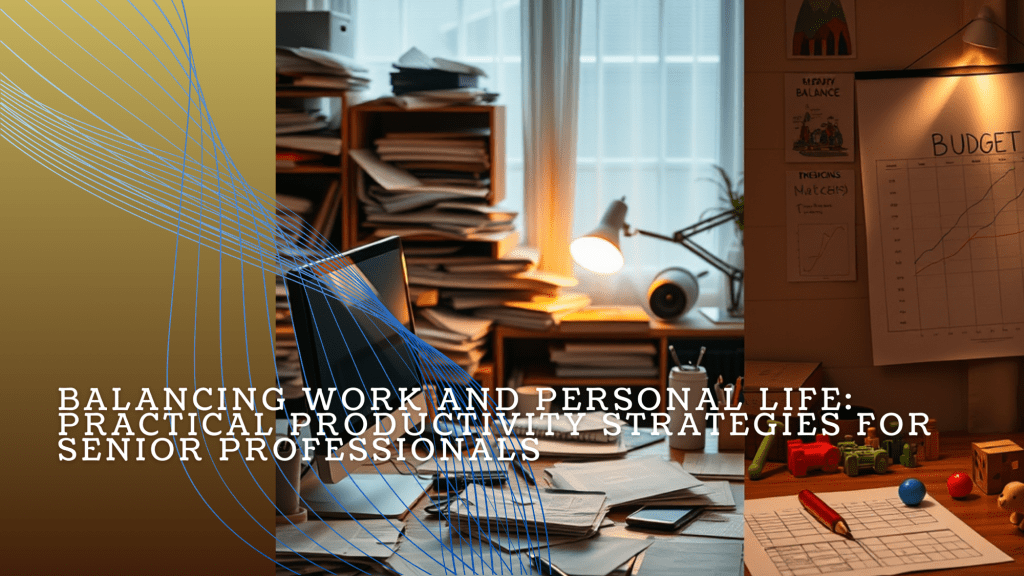
    It’s 7 PM, and you’re still at your desk, reviewing a report while your phone buzzes with reminders about a parent-teacher meeting and the family dog needing a walk. Meanwhile, your kid appears at the door with a masterpiece they’ve drawn—on your quarterly budget sheet. Welcome to the life of a senior professional balancing a demanding career and a lively household.

    We’ve all been there, and the key isn’t about doing more but about doing better. In this guide, we’ll share actionable strategies to boost productivity, protect your personal time, and laugh a little along the way.


    1. Setting the Foundation for Balance
    1.1. Define Priorities and Values

    Before we dive into fancy strategies, take a moment to ask yourself: What truly matters? Is it delivering stellar work or being present for family milestones? For most professionals, the answer is both—but achieving balance requires intentional effort.

    Start with a simple system like the Eisenhower Matrix:

    • Important + Urgent: Major deadlines, family emergencies.
    • Important + Not Urgent: Long-term goals like career growth or planning a family trip.
    • Not Important + Urgent: Delegate these (e.g., “urgent” emails about printer toner).
    • Not Important + Not Urgent: Just… don’t (hello, endless scrolling on social media).

    Funny enough, realizing what doesn’t matter is as liberating as finding a great babysitter.

    1.2. Establish Boundaries

    Let’s be honest: boundaries are hard when work demands attention, and family sees your home office as open season. But boundaries protect your sanity. Communicate your “do not disturb” times clearly at work and home.

    One of my friends taped a sign to his home office door: “Unless there’s blood, fire, or chocolate cake, please wait until 5 PM.” Surprisingly, it works. For both his kids and his colleagues.


    2. Mastering Time Management
    2.1. Time Blocking for Work and Family

    Ever feel like your day disappears in a blur of emails, meetings, and snack breaks for your kids? Enter time blocking. Dedicate specific times for deep work, meetings, family activities, and self-care.

    Example: Mornings for focused tasks, afternoons for collaboration, and evenings for family. Use apps like Google Calendar to color-code your schedule. Your life will go from chaos to organized chaos—progress!

    2.2. Embrace the 80/20 Rule

    The Pareto Principle—80% of results come from 20% of your efforts—is a lifesaver. For work, focus on high-impact tasks like client presentations or strategic planning. For personal life, skip elaborate birthday parties and prioritize meaningful moments (unless your kid insists on a unicorn theme).

    2.3. Create a Weekly Planning Ritual

    Set aside 30 minutes each week to map out work tasks, family events, and personal goals. Involve your partner if possible—it’s amazing how many double-bookings you can avoid with a quick sync. Bonus: Add buffer time for unexpected chaos (looking at you, last-minute science projects).


    3. Enhancing Productivity at Work
    3.1. Prioritize Deep Work

    Senior roles require focus, so carve out uninterrupted time for strategic tasks. Block off hours for “deep work” and protect them like your favorite coffee mug at the office.

    3.2. Delegate and Automate

    Not everything needs your touch. Delegate repetitive tasks and automate wherever possible—think scheduling tools, automated expense reports, or a meal delivery service that keeps your fridge stocked.

    3.3. Take Breaks to Recharge

    We’ve all hit that 3 PM slump where caffeine isn’t cutting it. Take regular breaks to recharge. A 10-minute walk or stretch can do wonders for your focus. And yes, stepping on a stray LEGO counts as cardio.


    4. Nurturing Personal Life and Well-Being
    4.1. Schedule Quality Family Time

    Make family time sacred. It doesn’t have to be elaborate—a weekly movie night or tech-free dinner works wonders. One colleague of mine swears by 15-minute “one-on-one” chats with each family member every day. (His dog got jealous, so now she gets her own walk-and-talk session.)

    4.2. Prioritize Self-Care

    Fitness, nutrition, and mental health aren’t optional—they’re survival tools. Even 20-minute workouts or a daily mindfulness practice can keep you sharp and energized. Pro tip: A quick workout beats a frustrated sigh at your inbox any day.

    4.3. Stay Present in the Moment

    Whether you’re on a Zoom call or building a LEGO castle, focus on that moment. Mindfulness techniques like deep breathing or gratitude journaling can help you stay grounded, even when chaos looms.


    5. Practical Tips for Senior Professionals
    5.1. Use Technology Wisely

    From shared family calendars to project management apps, technology can streamline both work and personal life. Just don’t let it dominate your day—turn off notifications after hours.

    5.2. Learn to Say No

    Overcommitment is the enemy of balance. Decline tasks that don’t align with your priorities. Remember, saying no to one thing means saying yes to something else—like family time or sleep.

    5.3. Build a Support System

    Lean on your network. Whether it’s a mentor, spouse, or friend, having someone to share the load with can make all the difference. And yes, hiring help (cleaners, tutors, or even a dog walker) is not cheating—it’s smart.


    Share Your Story

    Balancing work and personal life isn’t about perfection—it’s about progress. Small, intentional steps can lead to meaningful change. Whether it’s implementing boundaries, scheduling family dinners, or finally saying no to that endless email chain, you have the tools to thrive.

    Now it’s your turn: How do you juggle work and family? What’s one system or habit that’s been a game-changer for you? Share your stories in the comments—I’d love to hear what works for you and your family!

  • Servant Leadership: Putting Your Team First for Maximum Impact

    Servant Leadership: Putting Your Team First for Maximum Impact

    The Effortless Impact of Servant Leadership

    Leadership often feels like a juggling act—balancing the demands of your organization, team, and personal goals. But what if the secret to maximizing your impact lay in shifting focus from yourself to those you lead?

    Servant leadership, a concept championed by Robert K. Greenleaf, offers a framework for achieving extraordinary results by prioritizing your team’s growth and well-being. More than a management strategy, it’s a mindset that, when done right, makes leading look effortless.

    This article explores how adopting a servant leadership style can transform your team, organization, and leadership legacy while fostering a sense of ease and purpose.

    What Is Servant Leadership?

    Servant leadership flips traditional hierarchies on their heads. Instead of focusing on asserting authority, servant leaders concentrate on serving their team.

    At its core, this leadership style is defined by key principles:

    • Empathy: Understanding and sharing the feelings of your team members.
    • Listening: Actively engaging with team members’ ideas and concerns.
    • Stewardship: Acting as a caretaker of the team’s goals and growth.
    • Empowerment: Enabling team members to take ownership of their roles.

    By adopting these values, servant leaders create environments where trust, collaboration, and innovation flourish.

    Effortless Impact in Action

    Servant leadership isn’t about doing more; it’s about creating space for others to thrive, making the process of leading feel natural and intuitive.

    The Benefits of Servant Leadership
    1. Enhanced Team Performance

    Teams perform better when they feel valued. Servant leaders ensure their team has the tools, support, and encouragement needed to succeed. The result? A motivated, high-performing team that works seamlessly together.

    2. Stronger Relationships

    By prioritizing empathy and active listening, servant leaders build relationships founded on trust and mutual respect. These connections make resolving conflicts and achieving goals more intuitive and effective.

    3. Fostering Innovation

    Servant leadership creates a psychologically safe environment where team members feel confident sharing their ideas. This freedom drives creativity and forward-thinking solutions without micromanagement.

    4. Long-Term Success

    Companies like Southwest Airlines and Starbucks have embedded servant leadership into their cultures, reaping sustainable growth, loyal employees, and satisfied customers.

    Effortless Leadership Insight

    When you lead with service, results follow naturally. Instead of forcing outcomes, you create conditions where success emerges organically.

    How to Practice Servant Leadership
    1. Focus on Active Listening

    Effortless leaders listen more than they speak. By understanding your team’s challenges and ambitions, you can tailor your guidance to meet their needs.

    Practical Tip: In meetings, spend 70% of your time listening and only 30% speaking.

    2. Empower Your Team

    Delegation is key to both servant leadership and effortless management. Giving your team autonomy shows trust and encourages them to take initiative.

    Example: Assign responsibilities along with decision-making authority to let team members own their work.

    3. Lead with Empathy

    Understanding your team’s perspectives doesn’t mean lowering expectations. Instead, it’s about showing you care while holding them accountable.

    Action Step: Regularly check in with team members, not just about work but about how they’re doing personally.

    4. Prioritize Professional Growth

    Servant leaders view their role as a platform for others to grow. Invest in mentorship, training, and skill-building opportunities for your team.

    Insight: When your team evolves, so does your leadership. Their success is a reflection of yours.

    5. Cultivate a Culture of Service

    Effortless leaders create teams where service becomes the norm. Encourage collaboration, shared goals, and recognition of contributions.

    Quick Win: Celebrate collective achievements during team meetings, fostering a sense of shared purpose.

    Challenges in Servant Leadership

    Servant leadership isn’t without challenges. Some may misinterpret this approach as a lack of authority. Others might resist changes to hierarchical norms.

    Overcoming Obstacles Effortlessly
    • Set Clear Boundaries: While serving your team, maintain clarity about roles, responsibilities, and expectations.
    • Stay Resilient: Balancing empathy with assertiveness ensures that servant leadership remains effective, not indulgent.
    • Communicate the Why: Explain how servant leadership benefits both individuals and the organization.

    When approached with intention, these challenges become opportunities to refine your leadership style.

    Real-World Examples of Servant Leadership
    Satya Nadella: Microsoft’s Transformation

    Under Nadella’s servant leadership, Microsoft shifted from a competitive, top-down culture to one focused on collaboration and growth. This change not only revived the company’s innovation but also improved employee satisfaction.

    Howard Schultz: Starbucks’ Mission-Driven Culture

    Schultz built Starbucks into a global brand by prioritizing employees’ well-being, offering benefits, and fostering a sense of community. His people-first approach remains a cornerstone of the company’s success.

    These leaders exemplify how servant leadership can make transformative results feel seamless.

    Why Servant Leadership Matters Now More Than Ever

    In a fast-paced world, where employee burnout and disengagement are common, servant leadership offers a sustainable path forward. By fostering a sense of belonging, purpose, and growth, this approach ensures resilience in the face of change.

    Making It Look Effortless

    The secret to effortless leadership lies in focusing on what truly matters—your team. By serving them first, you set the stage for both individual and collective success, all while simplifying your own leadership journey.

    Lead with Service, Succeed with Ease

    Servant leadership is more than a method—it’s a philosophy that empowers others while elevating your leadership impact. By prioritizing empathy, empowerment, and growth, you create an environment where success flows naturally.

    As you step into the role of a servant leader, remember:

    Effortless leadership isn’t about doing less—it’s about doing what matters most. When you lead with service, you make the hard things look easy and inspire your team to do the same.

    Call to Action: Start small. In your next team interaction, focus on listening, empathizing, and empowering. Watch how these simple shifts transform your leadership—and your team.