Tag: BusyProfessional

  • The Minimalist Wheel of Life: A Simple Approach to Balance and Focus

    The Minimalist Wheel of Life: A Simple Approach to Balance and Focus

    In today’s world, we’re constantly asked to manage more — more goals, more categories, more tools to track our progress. The classic Wheel of Life method is a fantastic framework for self-reflection, but with its 8 to 12 categories, it can quickly feel overwhelming. For busy professionals, the last thing you need is another complex system that steals time instead of creating clarity.

    Minimalism offers a better way. Instead of trying to optimize every corner of life, a minimalist Wheel of Life helps you zoom in on what truly matters, giving you maximum clarity with minimum effort.

    🌐 What Is the Wheel of Life?

    The Wheel of Life is a personal development tool designed to visualize how balanced your life feels. Traditionally, you divide a circle into several segments (health, work, relationships, finances, hobbies, etc.) and rate each from 1–10. The resulting “wheel” shows where you’re rolling smoothly — or hitting bumps that throw you off course.

    ✨ The Minimalist Take: 4 Core Areas

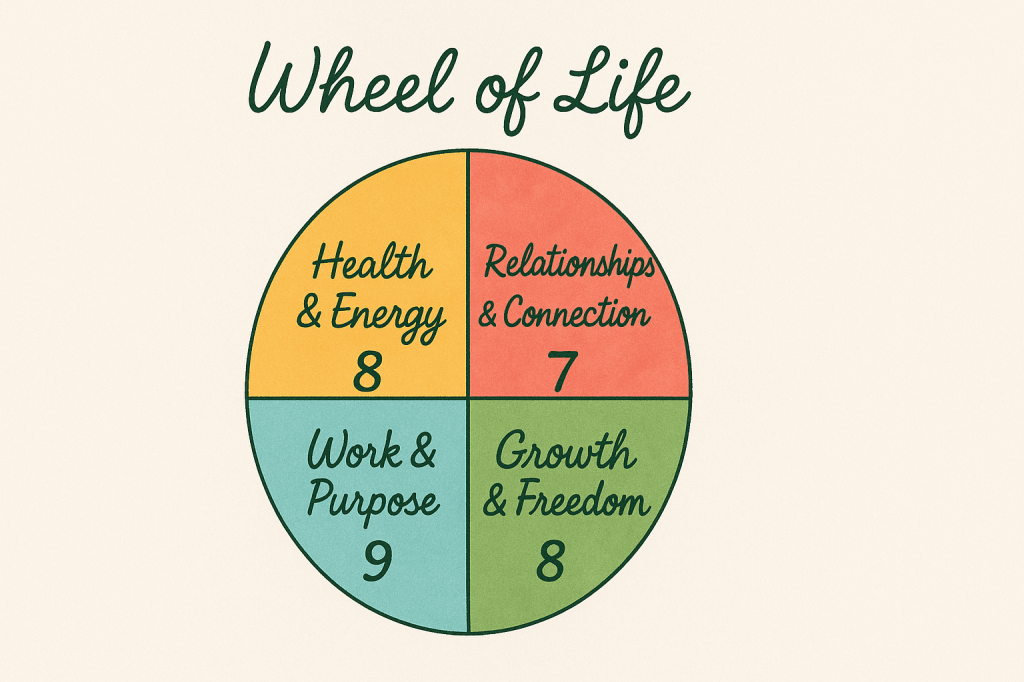
    Instead of juggling 8–12 categories, this streamlined version focuses on 4 key areas that influence everything else:

    1. 💪 Health & Energy: Your physical and mental foundation. Without good health, it’s nearly impossible to sustain performance anywhere else.
    2. 🤝 Relationships & Connection: Family, friendships, and colleagues. The quality of your connections shapes the quality of your days.
    3. 🚀 Work & Purpose: Your career, projects, or mission. Work provides structure, growth, and financial security — but also meaning.
    4. 🌱 Growth & Freedom: Personal growth, learning, hobbies, spirituality, and financial independence. These ensure you’re not just surviving but also expanding.

    With these four, you strip away the noise yet still capture the essence of a well-rounded life.

    🕒 How and When to Do It

    • Quarterly check-in: Once every three months is enough. Life doesn’t shift overnight, but this rhythm keeps you aligned.
    • Rate simply: Give each area a score from 1–10. No need for fancy visuals — four numbers on paper (or in your notes app) are enough.
    • Choose one focus: Instead of chasing improvement everywhere, ask: Which area, if improved, would create the biggest ripple effect?

    💡 Example: Getting consistent sleep and exercise (Health & Energy) will often boost your focus at work, patience at home, and motivation for growth.

    ⚖️ Why Balance Isn’t the Goal

    Here’s the key: life won’t always be balanced — and that’s okay. Sometimes one area will dominate your focus so you can make real progress. Maybe you’re pushing hard on a career project 🚀, or focusing on your health after a rough season 💪.

    The point isn’t to keep every category at a perfect 10 at all times. It’s about being aware, making intentional trade-offs, and then realigning when the time is right. Balance is dynamic, not static.

    🌟 Benefits of the Minimalist Wheel of Life

    • Clarity without overwhelm – Four categories are easy to reflect on.
    • Maximum leverage – Progress in one area cascades into the others.
    • Quick practice – Less than 10 minutes per quarter keeps it sustainable.
    • Intentional focus – Helps you decide where to lean in and where to accept “good enough.”

    Final Thought

    Minimalism isn’t about doing less for the sake of it. It’s about removing distractions so the essentials shine. The minimalist Wheel of Life does just that: it simplifies reflection, highlights your priorities, and gives you the clarity to act with purpose.

    Because in the end, life isn’t about juggling every category perfectly — it’s about knowing where to focus now, so you can move forward with balance in the long run. 🌿

  • The Menu Mindset: How to Juggle Work, Family, Fitness, and Social Life Without Burnout

    The Menu Mindset: How to Juggle Work, Family, Fitness, and Social Life Without Burnout

    We’ve all been there—staring at a massive to-do list that feels more like a prison sentence than a productivity tool. 📋 The more we add, the more behind we feel. For busy professionals, the list becomes endless: deadlines at work, family responsibilities, gym sessions, and a buzzing social calendar. Instead of motivating us, it drains us before the day even begins.

    Here’s the truth: your to-do list is already a menu. You just haven’t been looking at it that way. 🍽️

    Tim Ferriss once shared a brilliant analogy—stop treating your to-do list like a checklist you must grind through and start treating it like a diner menu. Not every dish is meant for you today. You simply choose the few that will nourish you best. This simple shift changes everything.

    The Burden of the “Must-Do” Mindset

    Most professionals attack their list with a “finish it all” mentality. That’s like walking into a diner and thinking you need to eat every dish. Ridiculous, right? Yet that’s how many of us operate—leading to stress, guilt, and burnout.

    The Menu Mindset in Action

    1. Work 🍵

    Instead of cramming 12 tasks into your day, ask: Which one project, if completed, moves the needle most? Do that first. The rest? Still on the menu tomorrow.

    2. Family ❤️

    A full schedule doesn’t mean neglecting loved ones. Look at your family “menu”: dinner together, walking the dog, bedtime story. Pick one and make it count. Quality beats quantity every time.

    3. Fitness 💪

    Forget rigid workout plans. See your exercise menu: strength, cardio, mobility. Some days you lift heavy, others you just row for 20 minutes. Both keep you consistent, both keep you sane.

    4. Social Life 🍷

    You don’t need to RSVP “yes” to everything. Social commitments are also a menu. One or two meaningful connections are often more nourishing than a packed weekend of small talk.

    Why This Works Effortlessly

    • ✅ No guilt over “unfinished” tasks—you were never meant to eat the whole menu.
    • ✅ Less decision fatigue—you focus on choosing, not forcing.
    • ✅ More joy—you tap into energy and desire, not obligation.

    When you approach life this way, balance isn’t something you chase—it becomes the natural outcome of choosing wisely from the menu in front of you.

    Takeaway

    Next time you look at your list, don’t think: “How can I possibly get through all this?”

    Instead ask: “What do I feel like choosing from today’s menu that will nourish me most—in work, family, fitness, and life?”

    Shift your mindset from get-through to get-to. That’s how you turn juggling life’s demands into something that looks—and feels—effortless. 🌿

  • The One-Minute Rule: A Micro-Habit That Clears Mental and Physical Clutter

    The One-Minute Rule: A Micro-Habit That Clears Mental and Physical Clutter

    Simplify your life one small action at a time—how a single rule can reshape your productivity, mindset, and environment.

    😫 Drowning in Tiny Tasks?

    Ever feel like you’re buried under a mountain of micro-responsibilities?

    📩 Emails piling up…

    🍽 Dishes in the sink…

    💬 Unread Slack messages…

    🧥 A coat draped over the chair since Tuesday…

    They seem too small to matter—yet they drain your energy and linger in the back of your mind. The One-Minute Rule might be the simplest solution you’ve never consistently used.

    ✅ What Is the One-Minute Rule?

    👉 If a task takes one minute or less, do it immediately.

    It’s that simple.

    Here are a few everyday examples:

    📧 Replying to a quick email

    🧥 Hanging up your jacket

    ☕ Washing your coffee cup

    📂 Filing one paper

    💻 Closing unused browser tabs

    🧠 Low mental effort. High payoff.

    🧬 Why It Works (The Psychology Behind It)

    The brilliance of the One-Minute Rule lies in behavioral science:

    🔋 Removes decision fatigue

    🧾 Breaks the “task debt” cycle

    🚀 Triggers momentum—action begets action

    🧘 Clears mental clutter and boosts control

    According to the Zeigarnik effect, our brains fixate on unfinished tasks. These “open loops” drain focus and increase stress.

    Closing these loops—one minute at a time—quietly reclaims energy.

    🛠 How to Use It Without Obsessing

    🎯 The goal isn’t perfection. It’s progress through simplicity.

    Here’s how to make it stick:

    🧠 Don’t overthink it—if you notice it, do it ⏰ Set 3 daily reminders (morning, midday, evening) 🧊 Use it as a warm-up before deep work 👨‍👩‍👧‍👦 Teach it to your team or kids as a culture hack

    Small actions compound—just like mess does. Why not let clarity be what multiplies?

    🌱 The Essentialist Angle: Small Habits, Big Results

    Minimalism isn’t about doing less—it’s about removing what doesn’t matter so you can focus on what does.

    🧭 One minute at a time, you reduce friction.

    💼 You free your mind to lead.

    🏡 You clear space to be present.

    💪 You reserve energy for your fitness, focus, and family.

    This rule isn’t just about getting things done—it’s about becoming the kind of person who gets things done effortlessly.

    🔄 Your Turn

    What’s one one-minute task you’ve been putting off today?

    🔁 Try the One-Minute Rule for 3 days.

    📓 Track how it shifts your mood, your focus, and your space.

    Then drop me a comment, DM, or reply—I’d love to hear what changed for you.

  • Master Time Blocking: The Proven Strategy to Take Control of Your Schedule and Boost Productivity

    Master Time Blocking: The Proven Strategy to Take Control of Your Schedule and Boost Productivity

    In an age where notifications pop up faster than thoughts, and multitasking is worn like a badge of honor, many professionals feel like they’re always working — but rarely making meaningful progress. The secret to cutting through this noise? It’s not a new app or an extra shot of espresso. It’s time blocking.

    Time blocking is a deceptively simple yet powerful method for managing your schedule and directing your focus where it matters most. Think of it as giving every hour of your day a job. Let’s dive in and turn your scattered to-dos into structured victories.


    What Is Time Blocking?

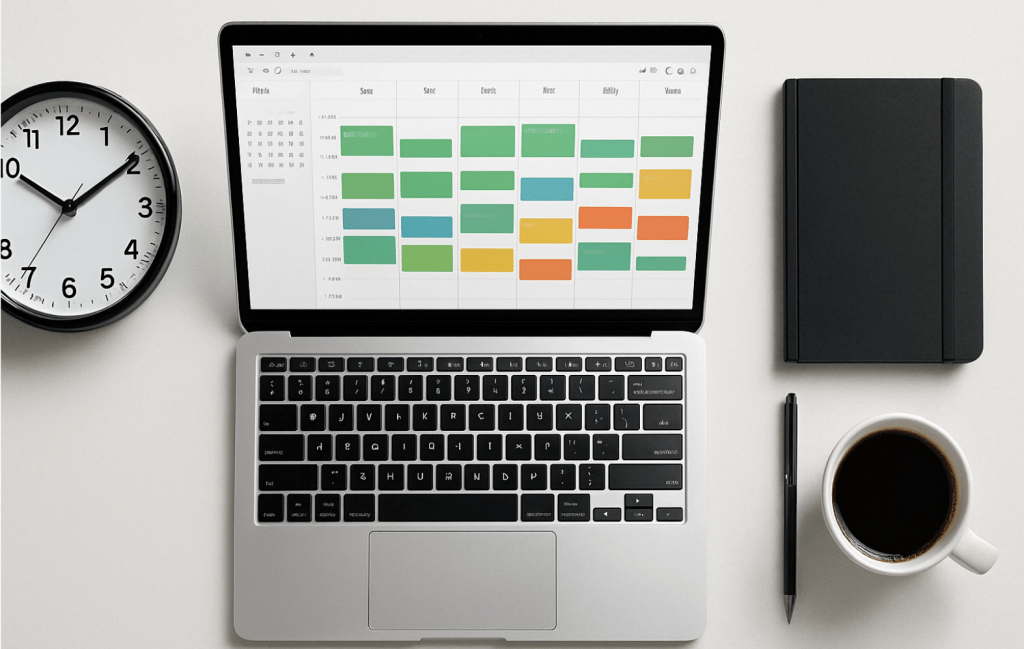
    Time blocking is the practice of dividing your day into discrete chunks of time, each dedicated to a specific task or category of work. Instead of keeping an open-ended to-do list that gets endlessly carried over, you assign specific tasks to specific time slots.

    For example, 9:00–11:00 AM might be for writing a report, 11:00–11:30 AM for email triage, and 1:00–2:00 PM for meetings. The beauty lies in the simplicity: focus on one thing at a time, without guilt about everything else.

    Unlike multitasking, which splits your focus and burns mental fuel fast, time blocking fosters deep work—intense concentration on one meaningful task at a time.


    Why Time Blocking Works (Backed by Psychology)

    Ever notice how a task expands to fill the time you give it? That’s Parkinson’s Law in action. Time blocking flips this law on its head. By putting boundaries around a task, you force yourself to work smarter and with more urgency.

    Plus, time blocking reduces decision fatigue. Instead of deciding in the moment what to do next (and risking a doom scroll instead), you follow your pre-decided plan like a GPS for your day.


    Types of Time Blocks You Can Use

    To make time blocking practical, think of your schedule like a Lego set. Here are the main block types you’ll use:

    • Deep Work Blocks – Reserved for focused, high-impact work like writing, strategic thinking, or coding. No emails, no Slack, no phone.
    • Admin Blocks – Knock out repetitive tasks like responding to emails, filing documents, or updating spreadsheets.
    • Buffer Blocks – Leave room for the unexpected: overflows, quick calls, or simply breathing room between intense sessions.
    • Personal Blocks – Don’t forget lunch, movement, or school runs. Life outside of work deserves structure too.
    • Theme Days – Dedicate entire days to one type of task, like “Meeting Monday” or “Content Friday.” Great for freelancers or team leads.

    How to Set Up a Time Blocking System That Works

    You don’t need to be a Type-A planner with color-coded markers to start time blocking. Here’s a simple roadmap:

    1. Audit Your Time
      For one day, track how you actually spend your time. You might be shocked how often “quick email checks” turn into Instagram detours.
    2. Define Priorities
      Identify your high-leverage tasks—the 20% that brings 80% of your results. Block time for these first.
    3. Choose Your Tools
      Start with Google Calendar, Notion, or a good old-fashioned planner. The best tool is the one you’ll actually use.
    4. Design Your Ideal Week
      Use recurring blocks where possible. Add deep work in the morning if that’s your peak energy time.
    5. Test and Adjust
      Life isn’t static. Treat your calendar like a working draft, not a prison sentence. Adjust weekly.

    Tools & Templates for Better Blocking

    A few tools that make time blocking ridiculously easy:

    • Google Calendar: Set recurring events, color-code blocks, and sync across devices.
    • Sunsama or Motion: Productivity apps that integrate task lists with time blocking.
    • Notion: Great for pairing your weekly planning with notes, goals, and project tracking.

    Bonus Tip: Create a printable weekly template to plan blocks every Sunday evening. Think of it as a ritual to prime your week for success.


    Avoid These Common Pitfalls

    Even a brilliant method like time blocking can backfire if you fall into these traps:

    • Overblocking: Packing every hour from 8 to 8 leaves no room for flexibility—and invites burnout.
    • Unrealistic Time Estimates: Always overestimate how long things take. Tasks expand. Life happens.
    • Skipping Breaks: You’re not a robot. Schedule short resets to boost your focus.
    • Ignoring Energy Levels: Match tough tasks with peak energy. Don’t schedule brainstorming after lunch if that’s your nap zone.

    Real-Life Example: A Day in a Time-Blocked Life

    Let’s look at an example for a working professional:

    Tuesday

    • 7:00–8:00 AM: Morning routine & family breakfast
    • 8:00–10:00 AM: Deep Work – Presentation prep
    • 10:00–10:30 AM: Break & walk
    • 10:30–12:00 PM: Client meetings
    • 12:00–1:00 PM: Lunch & recharge
    • 1:00–2:30 PM: Admin & follow-ups
    • 2:30–4:00 PM: Project planning
    • 4:00–4:30 PM: Buffer block
    • 5:00 PM onward: Workout, dinner, downtime

    Suddenly, your day has rhythm. You move with intention, not reaction.


    Level Up: Advanced Time Blocking Techniques

    • Time Boxing: Add a deadline to each block. “I’ll spend 45 minutes on this task—then I’m done.”
    • Batching: Group similar tasks to minimize context switching.
    • Weekly Reviews: Reflect on what worked, what didn’t, and adjust next week’s blocks.
    • Theme Days: Apply a broad theme to each day of your week. Helpful for solopreneurs or creators.

    Final Thoughts: Time Blocking Is Self-Respect in Action

    Time blocking isn’t about being rigid. It’s about being intentional. It’s a tool that helps you say yes to what matters and no to distractions.

    When you assign your hours with purpose, you move from scattered to strategic. From overwhelmed to in control.

    So, here’s your challenge: block just tomorrow. No need to over-engineer it. Choose your top three tasks and give them each a home on your calendar. Then show up.

    Because productivity isn’t about doing more — it’s about doing what matters, on purpose.

  • The Role of Minimalism in Achieving Work-Life Balance

    The Role of Minimalism in Achieving Work-Life Balance


    🌀 The Chaos We Call Balance

    You wake up, check emails before your feet hit the floor, rush the kids to school, sit through back-to-back Zoom calls, reply to Slack messages over lunch, manage a project milestone, and then, somehow, find yourself answering one last email in bed at 10:47 p.m.

    Sound familiar?

    For many professionals, balance feels more like juggling chainsaws than walking a tightrope. We add productivity hacks, new calendar apps, and time-saving gadgets—yet our schedules get fuller, our energy thinner, and our patience shorter.

    But what if the key to true work-life balance wasn’t more—but less?

    Welcome to the power of minimalism.


    ⚖️ What Work-Life Balance Actually Means

    Let’s clear something up: work-life balance isn’t about perfectly dividing your time between your job and personal life. It’s about intentional living—devoting your energy to what truly matters and filtering out the rest.

    Balance isn’t a 50/50 split.

    It’s:

    • Saying no to unnecessary meetings so you can say yes to dinner with your family.
    • Logging off when your brain needs rest, not just when your inbox is empty.
    • Letting go of “shoulds” in favor of what aligns with your values.

    And that’s where minimalism steps in—not as a trend, but as a compass.


    🔍 Minimalism: The Productivity Power-Up

    Minimalism is often misunderstood. It’s not about owning 10 things or living in a blank white room. It’s about clarity, focus, and removing the excess that clouds your judgment and steals your time.

    In a professional context, minimalism means:

    • Fewer priorities = Better focus
    • Less noise = Better thinking
    • Simpler systems = Smoother execution

    Research shows we make over 35,000 decisions a day. Every item on your desk, app on your phone, or tab in your browser adds to cognitive load. Minimalism reduces decision fatigue—leaving your mental energy for things that matter.


    🧠 Practical Applications at Work

    Here’s how minimalism works its magic at the office (or your kitchen table, if you’re working remotely):

    1. Declutter Your Calendar

    If your calendar looks like a game of Tetris, it’s time for a reset. Cut out recurring meetings that serve no real purpose. Ask: Does this need to happen? Could it be handled asynchronously?

    2. Single-Task Like a Pro

    Multitasking is a myth. Studies show it reduces productivity by up to 40%. Use time-blocking to focus on one task at a time. Tools like Pomodoro timers or apps like Forest can help you stay locked in.

    3. Apply the 80/20 Rule

    Chances are, 20% of your efforts yield 80% of your results. Identify high-impact tasks and ruthlessly prioritize them. Let go of the “busy work.”

    4. Master Email Minimalism

    Inbox zero is overrated. Check email 2-3 times a day—set a timer. Use labels, templates, and filters. Your inbox should work for you, not the other way around.


    🏡 Practical Applications at Home

    Now let’s bring that clarity into your personal life—where it really matters.

    1. Set Tech Boundaries

    Just because your phone is nearby doesn’t mean you need to be on-call. Create work shutdown rituals. For example: no emails after 7 p.m. or no screens in the bedroom.

    2. Simplify Your Space

    Visual clutter leads to mental clutter. Streamline your home setup—less décor, fewer distractions. A clear environment fosters a calm mind.

    3. Schedule Nothing

    Yes, you read that right. Leave blank space in your week. Time for spontaneity, reflection, even boredom. That’s when creativity—and deep connection—flourish.

    4. Be Present, Not Perfect

    You don’t need 5 hours of family time every day. You need 10 minutes of undivided attention. Trade quantity for quality. Put the phone away. Play a board game. Ask meaningful questions.


    🧭 The Minimalist Mindset: A Mental Shift

    Minimalism isn’t just about systems—it’s a philosophy.

    From FOMO to JOMO

    Let go of the Fear of Missing Out. Embrace the Joy of Missing Out. Say no to things that don’t align. Your energy is a finite resource—spend it wisely.

    The Power of “No”

    Every “yes” is a “no” to something else. Learn to say no to last-minute meetings, extra responsibilities, and social obligations that drain you.

    Self-Reflection is the Anchor

    Review your week. What brought you energy? What drained it? Use a minimalist journal to track your focus and adjust course. Minimalism requires regular realignment.


    👨‍👩‍👧‍👦 Real-Life Mini Case Studies

    Let’s make it real:

    • The Project Manager: Trimmed her meeting load by 30%—focused on strategic tasks, and finally had time to coach her team. Result? Less stress, better results.
    • The Young Family: Went screen-free after 7 p.m. for one week. Kids slept better, parents connected more. It became their new norm.
    • The Entrepreneur: Cleared his workspace, removed 70% of unused apps, and started time-blocking. He called it the most productive month of his career.

    These aren’t unicorns. They’re people like you—choosing less, and gaining more.


    🎒 Your Minimalist Work-Life Starter Pack

    Here’s how to start today:

    Declutter Your Digital Life
    — Delete unused apps
    — Unsubscribe from 10 newsletters
    — Use one to-do list app only

    Audit Your Calendar
    — Eliminate one low-value meeting
    — Add a 30-minute “deep work” block daily
    — Schedule a 24-hour window with no social plans

    Simplify Your Habits
    — Create a consistent morning ritual
    — Turn off phone notifications
    — Keep a “done” list to celebrate progress

    Bonus Tools to Try:

    • Notion: For streamlined project and task management
    • Minimalist: A clean, distraction-free to-do app
    • Sunsama: Plan your day with intention
    • Forest: Stay focused by planting virtual trees 🌱

    Final Thoughts: Simplicity Is Sustainable

    Work-life balance isn’t about perfection—it’s about presence. And minimalism helps you get there.

    By cutting the excess, you make space for what matters: deep work, meaningful rest, genuine connection, and peace of mind.

    Start small. Say no once. Clear one drawer. Remove one app. You’ll be amazed how quickly clarity compounds.


    📥 Want a quick win?
    Download your free checklist: “10 Minimalist Habits for a Balanced Work-Life”


    🗨️ What’s one thing you’ll simplify this week? Drop a comment and let’s inspire each other.