Tag: IntentionalLiving

  • The Minimalist Wheel of Life: A Simple Approach to Balance and Focus

    The Minimalist Wheel of Life: A Simple Approach to Balance and Focus

    In today’s world, we’re constantly asked to manage more — more goals, more categories, more tools to track our progress. The classic Wheel of Life method is a fantastic framework for self-reflection, but with its 8 to 12 categories, it can quickly feel overwhelming. For busy professionals, the last thing you need is another complex system that steals time instead of creating clarity.

    Minimalism offers a better way. Instead of trying to optimize every corner of life, a minimalist Wheel of Life helps you zoom in on what truly matters, giving you maximum clarity with minimum effort.

    🌐 What Is the Wheel of Life?

    The Wheel of Life is a personal development tool designed to visualize how balanced your life feels. Traditionally, you divide a circle into several segments (health, work, relationships, finances, hobbies, etc.) and rate each from 1–10. The resulting “wheel” shows where you’re rolling smoothly — or hitting bumps that throw you off course.

    ✨ The Minimalist Take: 4 Core Areas

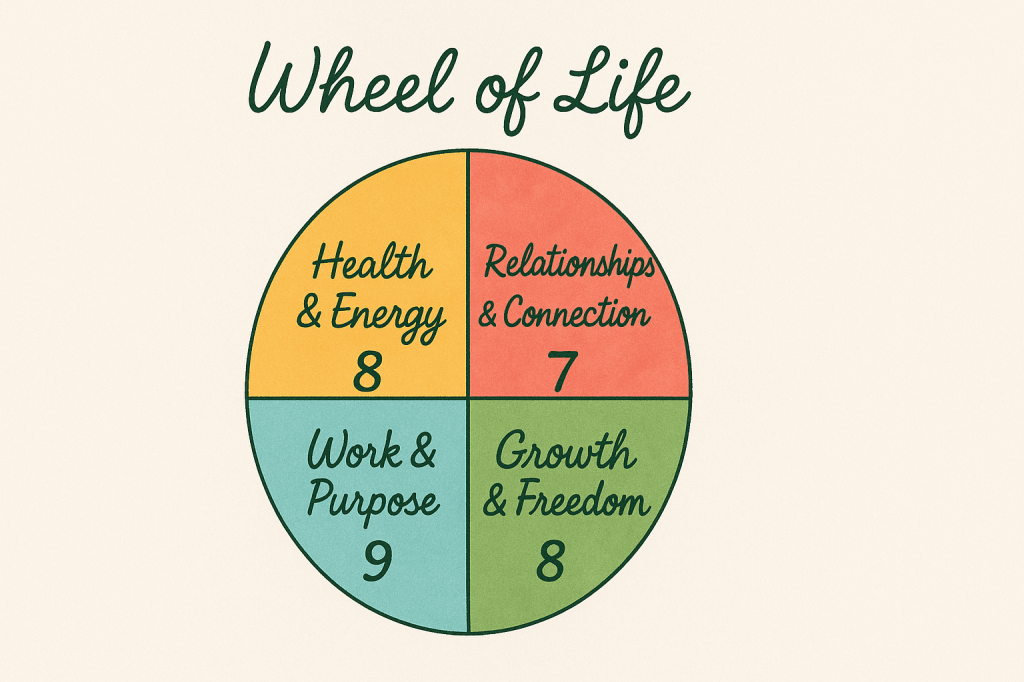
    Instead of juggling 8–12 categories, this streamlined version focuses on 4 key areas that influence everything else:

    1. 💪 Health & Energy: Your physical and mental foundation. Without good health, it’s nearly impossible to sustain performance anywhere else.
    2. 🤝 Relationships & Connection: Family, friendships, and colleagues. The quality of your connections shapes the quality of your days.
    3. 🚀 Work & Purpose: Your career, projects, or mission. Work provides structure, growth, and financial security — but also meaning.
    4. 🌱 Growth & Freedom: Personal growth, learning, hobbies, spirituality, and financial independence. These ensure you’re not just surviving but also expanding.

    With these four, you strip away the noise yet still capture the essence of a well-rounded life.

    🕒 How and When to Do It

    • Quarterly check-in: Once every three months is enough. Life doesn’t shift overnight, but this rhythm keeps you aligned.
    • Rate simply: Give each area a score from 1–10. No need for fancy visuals — four numbers on paper (or in your notes app) are enough.
    • Choose one focus: Instead of chasing improvement everywhere, ask: Which area, if improved, would create the biggest ripple effect?

    💡 Example: Getting consistent sleep and exercise (Health & Energy) will often boost your focus at work, patience at home, and motivation for growth.

    ⚖️ Why Balance Isn’t the Goal

    Here’s the key: life won’t always be balanced — and that’s okay. Sometimes one area will dominate your focus so you can make real progress. Maybe you’re pushing hard on a career project 🚀, or focusing on your health after a rough season 💪.

    The point isn’t to keep every category at a perfect 10 at all times. It’s about being aware, making intentional trade-offs, and then realigning when the time is right. Balance is dynamic, not static.

    🌟 Benefits of the Minimalist Wheel of Life

    • Clarity without overwhelm – Four categories are easy to reflect on.
    • Maximum leverage – Progress in one area cascades into the others.
    • Quick practice – Less than 10 minutes per quarter keeps it sustainable.
    • Intentional focus – Helps you decide where to lean in and where to accept “good enough.”

    Final Thought

    Minimalism isn’t about doing less for the sake of it. It’s about removing distractions so the essentials shine. The minimalist Wheel of Life does just that: it simplifies reflection, highlights your priorities, and gives you the clarity to act with purpose.

    Because in the end, life isn’t about juggling every category perfectly — it’s about knowing where to focus now, so you can move forward with balance in the long run. 🌿

  • 💳 “Subscription Detox” – Save Money, Clear Your Mind, Take Back Control

    💳 “Subscription Detox” – Save Money, Clear Your Mind, Take Back Control

    You know the drill:

    Free trial.

    Then €4.99/month.

    Then €14.99.

    Then suddenly you’re subscribed to seven streaming services, three productivity apps, two meditation platforms (that stress you out with daily reminders), and a magazine you haven’t read since 2022.

    But hey, it’s only a few bucks a month, right?

    Wrong.

    👉 In my recent “Subscription Detox,” I audited all recurring charges tied to my accounts.

    The results? Eye-opening:

    💸 Over €950/year wasted on unused or rarely used subscriptions.

    🧠 Countless moments of mental clutter—email spam, notification fatigue, decision fatigue from “which platform to watch/read/meditate on today?”

    We don’t talk enough about the hidden tax of convenience.

    Modern life is a buffet of bite-sized services. Everything is just a tap away. We subscribe to convenience, to potential, to aspiration.

    But here’s the trap:

    You’re not just spending money.

    You’re spending mental bandwidth maintaining relationships with tools you don’t even use.

    Every “free trial” comes with a silent cost:

    🔔 Another notification.

    📧 Another email.

    🧾 Another charge on your statement.

    And eventually…

    ⏳ Another minute wasted figuring out if you should cancel.

    So I made it simple. Here’s how I detoxed:

    1. Export your bank statement.

    Sort for recurring monthly and yearly charges. Highlight the ones you don’t recognize or haven’t used in 30+ days.

    2. Rank subscriptions by ROI.

    Does it truly add value? Save time? Bring joy? Or is it just there because you forgot to cancel after the trial?

    3. Ruthlessly cancel.

    Even if it feels small. Even if it might “one day” be useful. Future-you will thank you.

    4. Reinvest in freedom.

    Fewer subscriptions = fewer decisions = more clarity.

    After my detox, I felt like I had deleted 17 tabs open in my mind.

    Now, my money goes where my attention actually lives.

    🎯 A focused Spotify plan I use daily.

    🎯 A minimalist calendar app that brings me clarity.

    🎯 Zero guilt about not using the rest.

    It’s not just about saving €80/month.

    It’s about reclaiming your attention.

    💡 Because in a world constantly shouting for your subscription, sometimes the most powerful thing you can do… is unsubscribe.

    📌 Your turn:

    Do a “Subscription Detox” this weekend.

    Audit, cancel, and take back control.

    Then share your number:

    💬 How many subscriptions did you cancel?

    Let’s inspire each other to live with intention, not automation.

    🧘‍♂️ Less clutter.

    💰 More savings.

    🧠 Maximum clarity.

    You in?

  • Minimalist Goal-Setting: How to Prioritize What Truly Matters

    Minimalist Goal-Setting: How to Prioritize What Truly Matters

    In a world filled with endless distractions, constant pressure to perform, and a seemingly unending list of goals, it’s no wonder that many of us feel overwhelmed and stretched too thin. We set more goals than we can realistically achieve, and as a result, productivity suffers, relationships fray, and well-being declines. This is where minimalist goal-setting comes in—a powerful approach to reclaim focus, prioritize what truly matters, and make the hard things in life look effortless.

    Minimalist goal-setting isn’t about doing less for the sake of less; it’s about identifying what’s essential, cutting out the noise, and pursuing a path that’s both intentional and sustainable. In this article, we’ll explore how minimalist goal-setting can be applied to all areas of life—from personal growth to professional success, fitness, and personal style—and show you how to streamline your goals for greater impact.

    The Problem with Traditional Goal-Setting

    Traditional goal-setting methods often focus on doing more: more tasks, more activities, more deadlines. While this can sometimes yield temporary success, it often leads to burnout and frustration. The hustle culture that demands we constantly strive for more leaves little room for reflection, alignment, or meaningful progress.

    The problem lies in the assumption that the more goals we set, the more we accomplish. The reality, however, is that we rarely have the bandwidth to manage it all. Instead of focusing on achieving a laundry list of goals, minimalist goal-setting challenges us to focus on fewer, more impactful objectives that align with our core values and long-term vision.

    Key Concepts in Minimalist Goal-Setting
    1. Essentialism: Less But Better

    The philosophy of essentialism, popularized by Greg McKeown in his book Essentialism: The Disciplined Pursuit of Less, is the foundation of minimalist goal-setting. Essentialism teaches that we should prioritize only what is absolutely essential—what brings the most value and impact—while eliminating anything that doesn’t contribute meaningfully to our lives.

    By adopting an essentialist mindset, we can move away from “more is better” and instead ask ourselves, “What is the one thing that will make everything else easier or unnecessary?” Whether it’s in our personal life, career, or fitness goals, this approach ensures that our focus remains sharp and purposeful.

    2. The One-In, One-Out Rule

    One of the challenges of goal-setting is that we often pile on new ambitions without completing the ones we’ve already set. The one-in, one-out rule helps prevent this. For every new goal or task you add, make sure to remove or wrap up an existing one. This not only keeps your focus tight but also creates a sense of accomplishment as you make progress in each area.

    3. The Power of the “Anti-Goal”

    We often define goals in positive terms, such as “lose weight” or “increase sales.” However, the concept of the “anti-goal”—defining what you don’t want to achieve—can be just as powerful. For instance, you might set an anti-goal like, “I don’t want to feel burnt out” or “I don’t want to compromise my health for career success.” These anti-goals help create boundaries and guide us in saying “no” to opportunities that don’t align with our core values.

    4. Alignment Across Life Areas

    Minimalist goal-setting thrives on the idea that different areas of life—productivity, personal, fitness, and style—don’t have to compete for attention. Instead, they should support each other. Goals should align with one another, creating a harmonious flow rather than causing friction. When your professional goals complement your personal life or your fitness goals enhance your productivity, the effort you put into one area positively impacts the others.

    Application Across Life Domains

    Now that we’ve covered the core concepts of minimalist goal-setting, let’s explore how to apply these principles across different areas of life.

    1. Productivity Goals

    At the heart of minimalist goal-setting is productivity. However, productivity isn’t about doing more; it’s about doing less, more effectively. To start, apply the Rule of Three: choose no more than three major objectives for each quarter, month, or week. This keeps you focused on what truly matters and prevents overwhelm.

    Use tools like the Eisenhower Matrix to prioritize tasks: distinguish between what’s urgent versus important, and delegate or eliminate tasks that fall outside these categories. Creating systems—rather than setting individual, complex goals—will make your productivity more sustainable and less taxing.

    2. Professional Goals

    In your professional life, embrace a minimalist approach by focusing on what creates the most value. Instead of setting a vast array of KPIs or goals, think in terms of “theme goals.” For instance, rather than aiming to improve multiple skills at once, set a theme for the year such as “Improving Delegation” or “Enhancing Strategic Thinking.” This simplifies your focus and gives you direction without spreading yourself too thin.

    Furthermore, align your goals with your personal strengths. Ask yourself: What do I do best, and how can this skillset help my team or company? By concentrating on what you excel at, you can make a greater impact without the pressure of tackling everything at once.

    3. Personal Goals

    When it comes to personal development, minimalist goal-setting can transform how you approach growth. Instead of focusing on dozens of vague personal goals, aim to define your identity. For example, you might set a goal like “Be a present father” or “Live with intention.” These identity-driven goals are easier to align with, and they help you stay grounded in what truly matters.

    Use journaling or monthly reviews to check your progress, ensuring that your goals are still aligned with your values. This reflective process helps prevent the pursuit of goals that aren’t fulfilling.

    4. Fitness & Health Goals

    Health and fitness are often neglected when life gets busy, but minimalist goal-setting can make maintaining a healthy lifestyle easier. Rather than signing up for intense workout regimens or trying the latest fitness trends, focus on the minimum effective dose that provides sustainable results.

    For example, instead of committing to an exhaustive exercise routine, focus on strength training three times a week, complemented by daily walking and stretching. This simple approach yields significant benefits while keeping your routine manageable. Similarly, prioritize key health practices like sleep, hydration, and protein intake to fuel your body for success in all other areas.

    5. Personal Style Goals

    Personal style is often overlooked when setting goals, yet it plays a crucial role in your self-esteem and professional presence. A minimalist approach to style—such as creating a capsule wardrobe—simplifies your clothing choices and helps you dress with intention. By investing in timeless, versatile pieces that you truly love, you can reduce decision fatigue while maintaining a polished look.

    Consider quarterly style reviews to assess your wardrobe, refine your look, and make adjustments as needed. This approach helps you stay intentional with your clothing choices without the need to constantly shop or follow fleeting fashion trends.

    How These Areas Support Each Other

    Minimalist goal-setting isn’t just about simplifying individual areas of life; it’s about creating a harmonious balance where each area supports the others. For example, focusing on fitness can improve your energy levels, making you more productive in your career. When you prioritize your personal life and relationships, you’ll feel more grounded, which in turn allows you to be more present and focused at work. Personal style, while seemingly unrelated, boosts confidence, which can improve both your professional interactions and personal relationships.

    By integrating minimalist principles across all areas of life, you create a feedback loop that fosters success and well-being.

    A Simple Minimalist Goal-Setting Framework

    To get started with minimalist goal-setting, follow this simple framework:

    1. Vision: What kind of life are you building? Visualize your ideal life in terms of work, family, health, and personal development.
    2. Focus Areas: Choose 3–5 domains (e.g., work, health, family, growth, style) that reflect your vision.
    3. One Keystone Goal per Area: For each focus area, identify the one goal that will elevate everything else.
    4. Weekly Check-ins: Assess your progress, adjust your priorities, and make sure you’re staying true to your vision.
    5. Quarterly Reviews: Reflect on your goals, cut what no longer serves you, and recommit to what truly matters.
    Conclusion

    Minimalist goal-setting isn’t about doing less for the sake of less; it’s about doing less of what doesn’t matter and more of what does. By prioritizing the essential and aligning your goals across all areas of life, you can achieve greater success with less stress. The process is simple, but its impact is profound—helping you not only accomplish your goals but do so in a way that makes the hard things look effortless.

    Remember, you don’t need more goals—you need fewer that matter more. By embracing minimalist goal-setting, you’ll clear the clutter and create a life that’s both intentional and fulfilling.

  • Master Time Blocking: The Proven Strategy to Take Control of Your Schedule and Boost Productivity

    Master Time Blocking: The Proven Strategy to Take Control of Your Schedule and Boost Productivity

    In an age where notifications pop up faster than thoughts, and multitasking is worn like a badge of honor, many professionals feel like they’re always working — but rarely making meaningful progress. The secret to cutting through this noise? It’s not a new app or an extra shot of espresso. It’s time blocking.

    Time blocking is a deceptively simple yet powerful method for managing your schedule and directing your focus where it matters most. Think of it as giving every hour of your day a job. Let’s dive in and turn your scattered to-dos into structured victories.


    What Is Time Blocking?

    Time blocking is the practice of dividing your day into discrete chunks of time, each dedicated to a specific task or category of work. Instead of keeping an open-ended to-do list that gets endlessly carried over, you assign specific tasks to specific time slots.

    For example, 9:00–11:00 AM might be for writing a report, 11:00–11:30 AM for email triage, and 1:00–2:00 PM for meetings. The beauty lies in the simplicity: focus on one thing at a time, without guilt about everything else.

    Unlike multitasking, which splits your focus and burns mental fuel fast, time blocking fosters deep work—intense concentration on one meaningful task at a time.


    Why Time Blocking Works (Backed by Psychology)

    Ever notice how a task expands to fill the time you give it? That’s Parkinson’s Law in action. Time blocking flips this law on its head. By putting boundaries around a task, you force yourself to work smarter and with more urgency.

    Plus, time blocking reduces decision fatigue. Instead of deciding in the moment what to do next (and risking a doom scroll instead), you follow your pre-decided plan like a GPS for your day.


    Types of Time Blocks You Can Use

    To make time blocking practical, think of your schedule like a Lego set. Here are the main block types you’ll use:

    • Deep Work Blocks – Reserved for focused, high-impact work like writing, strategic thinking, or coding. No emails, no Slack, no phone.
    • Admin Blocks – Knock out repetitive tasks like responding to emails, filing documents, or updating spreadsheets.
    • Buffer Blocks – Leave room for the unexpected: overflows, quick calls, or simply breathing room between intense sessions.
    • Personal Blocks – Don’t forget lunch, movement, or school runs. Life outside of work deserves structure too.
    • Theme Days – Dedicate entire days to one type of task, like “Meeting Monday” or “Content Friday.” Great for freelancers or team leads.

    How to Set Up a Time Blocking System That Works

    You don’t need to be a Type-A planner with color-coded markers to start time blocking. Here’s a simple roadmap:

    1. Audit Your Time
      For one day, track how you actually spend your time. You might be shocked how often “quick email checks” turn into Instagram detours.
    2. Define Priorities
      Identify your high-leverage tasks—the 20% that brings 80% of your results. Block time for these first.
    3. Choose Your Tools
      Start with Google Calendar, Notion, or a good old-fashioned planner. The best tool is the one you’ll actually use.
    4. Design Your Ideal Week
      Use recurring blocks where possible. Add deep work in the morning if that’s your peak energy time.
    5. Test and Adjust
      Life isn’t static. Treat your calendar like a working draft, not a prison sentence. Adjust weekly.

    Tools & Templates for Better Blocking

    A few tools that make time blocking ridiculously easy:

    • Google Calendar: Set recurring events, color-code blocks, and sync across devices.
    • Sunsama or Motion: Productivity apps that integrate task lists with time blocking.
    • Notion: Great for pairing your weekly planning with notes, goals, and project tracking.

    Bonus Tip: Create a printable weekly template to plan blocks every Sunday evening. Think of it as a ritual to prime your week for success.


    Avoid These Common Pitfalls

    Even a brilliant method like time blocking can backfire if you fall into these traps:

    • Overblocking: Packing every hour from 8 to 8 leaves no room for flexibility—and invites burnout.
    • Unrealistic Time Estimates: Always overestimate how long things take. Tasks expand. Life happens.
    • Skipping Breaks: You’re not a robot. Schedule short resets to boost your focus.
    • Ignoring Energy Levels: Match tough tasks with peak energy. Don’t schedule brainstorming after lunch if that’s your nap zone.

    Real-Life Example: A Day in a Time-Blocked Life

    Let’s look at an example for a working professional:

    Tuesday

    • 7:00–8:00 AM: Morning routine & family breakfast
    • 8:00–10:00 AM: Deep Work – Presentation prep
    • 10:00–10:30 AM: Break & walk
    • 10:30–12:00 PM: Client meetings
    • 12:00–1:00 PM: Lunch & recharge
    • 1:00–2:30 PM: Admin & follow-ups
    • 2:30–4:00 PM: Project planning
    • 4:00–4:30 PM: Buffer block
    • 5:00 PM onward: Workout, dinner, downtime

    Suddenly, your day has rhythm. You move with intention, not reaction.


    Level Up: Advanced Time Blocking Techniques

    • Time Boxing: Add a deadline to each block. “I’ll spend 45 minutes on this task—then I’m done.”
    • Batching: Group similar tasks to minimize context switching.
    • Weekly Reviews: Reflect on what worked, what didn’t, and adjust next week’s blocks.
    • Theme Days: Apply a broad theme to each day of your week. Helpful for solopreneurs or creators.

    Final Thoughts: Time Blocking Is Self-Respect in Action

    Time blocking isn’t about being rigid. It’s about being intentional. It’s a tool that helps you say yes to what matters and no to distractions.

    When you assign your hours with purpose, you move from scattered to strategic. From overwhelmed to in control.

    So, here’s your challenge: block just tomorrow. No need to over-engineer it. Choose your top three tasks and give them each a home on your calendar. Then show up.

    Because productivity isn’t about doing more — it’s about doing what matters, on purpose.

  • Simplify to Thrive: A Busy Dad’s Guide to Minimalism

    Simplify to Thrive: A Busy Dad’s Guide to Minimalism

    Picture this: It’s a Monday evening. You’ve just wrapped up a demanding day at work, racing against deadlines and managing a barrage of emails. As you pull into the driveway, you’re already switching gears to help your kids with their homework. A quick glance at the clock reminds you that soccer practice starts in 20 minutes. Dinner still needs prepping, your parents called earlier with something they need help with, and you promised your spouse some quality time after the kids go to bed. Amidst all this, where’s the space for you?

    As a dad juggling a demanding career, family life, and personal health, it can feel like you’re sprinting on a never-ending treadmill. But what if there’s a way to step off, breathe, and bring order to the chaos? That’s where minimalism comes in—not just as a way of owning fewer things but as a mindset to help you focus on what truly matters.

    In this article, I’ll walk you through how minimalism can transform your life as a busy dad, sharing practical tips and personal insights along the way.


    The Modern Dad’s Dilemma

    Let’s start with the reality of the modern dad’s life. You wear countless hats—employee, husband, father, son, coach, and maybe even mentor. Each role comes with its own set of demands.

    At work, you’re expected to deliver results, often in a high-pressure environment where “being available” extends well beyond 9-to-5. I remember the time I had to take a client call during my daughter’s school recital. I’ll never forget the look of disappointment on her face as I stepped out.

    At home, you’re managing everything from homework help to chauffeuring kids to soccer and dance classes. Weekends? Forget about relaxing—they’re filled with birthday parties, home repairs, and grocery runs. And let’s not even get started on trying to fit in a workout or prepping a healthy meal for yourself.

    Adding to this, many of us are part of the “sandwich generation,” supporting aging parents while raising young children. And in the middle of it all, there’s your marriage, the foundation of your family, which also needs nurturing.

    It’s no wonder so many of us feel overwhelmed, burnt out, and constantly behind.


    What is Minimalism for a Busy Dad?

    When most people hear “minimalism,” they think of bare walls and owning just 30 items of clothing. But minimalism isn’t about deprivation; it’s about focus.

    For a busy dad, minimalism is the practice of cutting out the non-essential—whether it’s clutter, commitments, or distractions—to create space for what matters most. It’s about spending time and energy intentionally, instead of spreading yourself too thin.

    When I first started embracing minimalism, it wasn’t about throwing out half my stuff. It began with asking myself one simple question: “What do I truly value?” For me, the answers were clear—my family, my health, and meaningful work. Everything else? It could wait.


    The Key Pillars of Minimalism for a Busy Dad
    1. Prioritization

    Minimalism starts with identifying what matters most to you. For me, this meant making family dinners non-negotiable, scheduling regular workouts, and setting boundaries at work.

    One trick I use is the “big rocks” method. Imagine your day as a jar. The big rocks are your priorities—family, health, work. The pebbles are less important tasks, and the sand is the fluff. If you fill your jar with sand first, there’s no room for the big rocks. But if you start with the big rocks, everything else can fit around them.

    2. Streamlining

    Life is full of small decisions that drain your energy. Streamlining means automating or simplifying these as much as possible.

    • Meal Prepping: Every Sunday, my wife and I spend an hour planning and prepping meals for the week. It’s not just efficient—it’s a great way to bond.
    • Capsule Wardrobe: I simplified my wardrobe to a few versatile, high-quality pieces. Now, getting dressed takes seconds, and I always feel confident.
    • Shared Calendars: Our family uses a shared digital calendar to keep track of everything from school events to doctor appointments.
    3. Letting Go

    One of the hardest lessons for me was learning to say no. But every time you say yes to something unimportant, you’re saying no to something that truly matters.

    A few months ago, I turned down a work project that would have required weekend hours. It wasn’t easy, but it meant I could coach my son’s soccer game and be present for my family.

    Letting go also applies to physical clutter. We made a family activity out of decluttering the kids’ playroom. Not only did it create a more peaceful space, but it also taught them the value of simplicity.


    Practical Steps to Embrace Minimalism
    1. Manage Your Time

    Start with time-blocking. Dedicate chunks of your day to specific tasks—work, family, fitness—and stick to it. For example, I block off 6-8 pm every evening for family time. No work emails, no distractions.

    2. Declutter Physical Space

    A cluttered home creates a cluttered mind. Start small—maybe with your closet or the kitchen counter. One weekend, I tackled the garage, turning it from a chaotic storage dump into a functional space. The mental clarity that followed was incredible.

    3. Shift Your Mindset

    Minimalism isn’t just about doing less; it’s about appreciating more. Each night, I write down three things I’m grateful for. This simple practice has shifted my perspective, helping me focus on abundance rather than lack.

    4. Involve Your Family

    Minimalism works best when it’s a family effort. We’ve set simple rules, like “one new toy in, one old toy out.” The kids love the challenge of deciding what to let go of.


    The Benefits of Minimalism for a Busy Dad
    1. Work-Life Balance

    By focusing on what’s truly important, I’ve become more productive at work and more present at home. Minimalism taught me that success isn’t about doing everything—it’s about doing the right things.

    2. Stronger Family Connections

    With fewer distractions, I’ve been able to deepen my relationships with my wife and kids. We now have more time for family game nights, Sunday hikes, and just sitting down to talk.

    3. Better Health

    With more time and energy, I’ve finally committed to regular workouts and healthier eating. The result? I feel stronger, more energized, and better equipped to handle life’s demands.

    4. Mental Clarity

    Decluttering my life—both physically and mentally—has reduced my stress levels dramatically. I no longer feel like I’m constantly playing catch-up.


    Conclusion

    Minimalism isn’t about giving things up—it’s about gaining more. More time for your family, more energy for your health, and more clarity for your goals.

    If you’re a busy dad feeling stretched too thin, take the first step today. Maybe it’s saying no to an unnecessary commitment, decluttering a single drawer, or setting aside 30 minutes of uninterrupted family time. Small changes can lead to big transformations.

    Remember, you don’t have to do it all. By simplifying your life, you can start thriving instead of just surviving.