Tag: lifting

  • Biceps, Brains, and Boardrooms: How Strength and Fitness Build Unstoppable Influence

    Biceps, Brains, and Boardrooms: How Strength and Fitness Build Unstoppable Influence

    In the cutthroat world of business, power is often thought to come from intelligence, persuasion, and strategy. But what if I told you that the size of your biceps could also play a vital role in your ability to dominate boardroom meetings and close deals? History, philosophy, and science suggest that physical strength and mental acuity are inextricably linked—and those who neglect their physical conditioning risk falling behind their more muscular competitors.

    To paraphrase Theodore Roosevelt, “Strength and effort are the foundation of greatness.” With this in mind, let’s explore why larger muscle bellies might just be your secret weapon for professional dominance—and how you can cultivate the physical and mental might to reign supreme.

    The Philosophy of Power: Strength as a Prerequisite for Leadership
    Socrates: The Shame of Ignoring Your Potential

    Socrates believed that physical conditioning was essential to achieving one’s full potential. He famously said, “It is a shame for a man to grow old without seeing the beauty and strength of which his body is capable.” Imagine walking into a negotiation room. Your handshake alone tells a story of discipline, resilience, and capability. Weakness in the body implies weakness in resolve—a perception no leader can afford to project.

    Nietzsche: Overcoming Weakness

    Friedrich Nietzsche’s concept of the Übermensch glorifies strength and the will to overcome challenges. For Nietzsche, physical power wasn’t just about appearances but about cultivating the strength to shape reality. In the boardroom, this translates to the ability to project confidence, endure pressure, and assert your authority—all of which are amplified by the presence of well-developed, commanding biceps.

    Why Biceps Matter: The Psychology of Strength

    The connection between physical strength and leadership isn’t just philosophical—it’s biological. Studies in evolutionary psychology show that people often associate physical size and muscularity with competence and dominance. A commanding physique doesn’t just influence others subconsciously; it affects how you carry yourself.

    When your muscles are strong, you stand taller, speak with conviction, and move with purpose. As Marcus Aurelius, the Stoic emperor and philosopher, once said, “You have power over your mind—not outside events. Realize this, and you will find strength.” Physical strength fortifies mental resilience, giving you the edge in high-pressure environments like boardroom negotiations.

    How to Build Your Boardroom Biceps and Mental Might

    It’s time to take action. Theodore Roosevelt, one of history’s grittiest leaders, overcame childhood asthma and weakness through rigorous physical training. His relentless pursuit of fitness became the foundation of his legendary leadership. Let his example inspire you to prioritize strength as a cornerstone of your success.

    1. Lift Heavy, Negotiate Harder

    To dominate the boardroom, you need functional, commanding strength. Focus on compound exercises that build overall muscle mass and power:

    • Pull-ups for grip strength and biceps dominance.
    • Deadlifts for a strong posterior chain and unshakeable presence.
    • Bench presses for a powerful chest and assertive posture.
    2. Train Your Mind Like Your Muscles

    Just as you challenge your body, challenge your intellect. Read broadly, practice critical thinking, and refine your arguments with relentless preparation. As Aristotle said, “The educated differ from the uneducated as much as the living from the dead.” Pairing a sharp mind with a strong body makes you unstoppable.

    3. Master Your Presence

    Your physical presence speaks volumes before you even open your mouth. Maintain a firm handshake, confident eye contact, and a relaxed but upright posture. Remember, Nietzsche’s Übermensch doesn’t just exist—he commands attention.

    4. Fuel for Power

    Nutrition fuels both mental and physical strength. Prioritize high-quality protein, healthy fats, and nutrient-dense foods to build muscle and sustain focus. As Rousseau suggested in Émile, “A sound mind in a sound body” is the foundation of greatness.

    Actionable Strategies for Winning in the Boardroom

    When you’ve built the physical foundation, it’s time to flex your metaphorical muscles in professional settings:

    • Use Your Strength as a Metaphor: Share stories of physical challenges you’ve overcome to build rapport and showcase resilience.
    • Project Calm Under Pressure: Physical conditioning helps you manage stress. Practice deep breathing during tense negotiations to maintain control.
    • Dominate Nonverbal Communication: Your physique reinforces your words. Lean forward slightly to emphasize points and hold your ground during disagreements.
    The Bicep Philosophy: Why It All Comes Together

    At the end of the day, the size of your biceps isn’t just about aesthetics—it’s about what they represent. Strength, discipline, and resilience are virtues praised by thinkers like Plato, who believed that “The first and greatest victory is to conquer yourself.” By committing to physical and mental excellence, you embody the qualities that inspire respect, loyalty, and trust in any arena.

    So grab a set of weights, clear your mind, and remember: every rep, every argument, and every challenge is a step closer to the unshakable power you were born to wield. You’re not just lifting weights—you’re lifting your legacy.

    No guts, no glory. No strength, no success. Go out there and dominate.

  • Quick and Effective Workouts for Busy Professionals: Maximize Your Time

    Quick and Effective Workouts for Busy Professionals: Maximize Your Time

    For busy professionals, squeezing in a workout can often feel like a luxury. However, with the right approach, you can turn a brief workout session into a powerful tool for enhancing both your career and personal life. Imagine this: a high-powered executive who juggles board meetings, client calls, and family time. What if just 20 minutes of strength training could transform his energy levels, improve focus, and even strengthen family bonds?

    Intensity Approaches for Optimal Results

    Approach 1: High Load, Low Reps This strategy focuses on heavy weights and fewer reps, ideal for building raw strength and power. Think of it as the professional’s “secret weapon” for conquering the most demanding projects with a clear, focused mind.

    Approach 2: Lower Load, Higher Reps With moderate weights and higher reps, this method enhances muscle endurance and growth. It’s akin to maintaining the stamina needed for those long, unpredictable days in the office while staying sharp and efficient.

    Sample Workouts

    Workout 1: High Load, Low Reps

    • Squats: 3 sets x 3 reps
    • Bench Press: 3 sets x 5 reps

    Imagine this: You’re finishing your last set of squats, feeling the rush of adrenaline and focus. You walk back to your desk, feeling stronger and more capable. The result? Enhanced performance at work and a renewed sense of confidence that extends beyond the gym.

    Workout 2: High Load, Low Reps

    • Deadlifts: 5 sets x 2 reps
    • Overhead Press: 3 sets x 6 reps

    Picture this: As you power through your deadlifts, you’re not just lifting weights; you’re lifting the burden of stress off your shoulders. By the end of your workout, you’re not only physically stronger but mentally sharper, ready to tackle complex problems and lead your team with renewed vigor.

    Workout 3: Lower Load, Higher Reps

    • Front Squats: 6 sets x 8 reps
    • Weighted Dips: 6 sets x 6 reps

    Think of this: You complete your front squats and weighted dips with a sense of accomplishment. The endorphins kick in, and you’re now equipped to handle the daily grind with a more resilient mindset, making your professional life smoother and your evenings with family more enjoyable.

    Workout 4: Lower Load, Higher Reps

    • Romanian Deadlift: 4 sets x 12 reps
    • (Weighted Pullup): 6 sets x 8 reps

    Envision this: Your Romanian deadlifts and Pullups are not just exercises; they’re moments of mental clarity and strength building. You leave the gym feeling not just physically but emotionally revitalized, ready to be present and engaged at home.

    Training Frequency and Progression

    To maximize your results and integrate fitness seamlessly into your life:

    • Train 2 to 3 Times a Week: Rotate through the different workouts to ensure balanced muscle development and prevent overtraining. You’ll find that this consistency makes you more resilient and effective both at work and in your personal life.
    • Progressive Overload: Each time you return to a workout, challenge yourself to lift heavier or push harder. This continual progression not only enhances physical strength but also builds mental resilience, helping you tackle daily challenges with confidence.
    • Track Your Progress: Keeping a workout journal to monitor weights, sets, and reps allows you to see tangible progress. This sense of achievement can translate into greater satisfaction in your professional and personal life.
    The Broader Benefits

    Physical Health: Regular strength training boosts cardiovascular health, improves metabolic function, and supports better posture. For busy professionals, this means fewer sick days and increased overall vitality.

    Mental Health: Engaging in strength training releases endorphins, which can reduce stress, anxiety, and depression. This mental clarity and reduced stress can make you more effective at work and more patient and present with your family.

    Family Life: By investing in your health, you set an example for your family and ensure you have the energy and mental clarity to enjoy quality time with them. Imagine returning home from a workout not feeling drained but invigorated and ready to engage in meaningful activities with loved ones.

    Conclusion

    For the busy professional, a well-designed workout can be a game-changer. By focusing on high-impact compound exercises and utilizing strategic intensity approaches, you can enhance both your work performance and personal life. With just 20 minutes of efficient strength training a few times a week, you’ll not only see physical transformations but also experience improved mental clarity and resilience. So, take the plunge and make these quick, effective workouts a part of your routine. The benefits will ripple through your career, health, and family life, making every minute count.

  • Give It Your All: Embracing the Power of Commitment in Strength Training

    Give It Your All: Embracing the Power of Commitment in Strength Training

    When it comes to strength training, there’s a powerful truth that stands above all others: progress demands effort. Achieving real, tangible results in the gym doesn’t come from half-hearted attempts or distracted workouts. It comes from a relentless commitment to each rep, each set, and each moment spent training. If you aspire to cultivate lasting strength and resilience, you must respect and intensify your time in the gym. You don’t need to live in the gym or let your training dominate your entire life. However, when you step into that sacred space, it’s imperative to give it your all.

    This article delves into the profound significance of full commitment during your workouts. It’s about mastering the art of balancing dedication with a healthy perspective on obsession. True progress is achieved not just by working hard but by maintaining a balanced and healthy approach to life outside of training. Let’s explore how committing fully to each session propels you toward your goals and why your “all” might look different from day to day.

    Dedication vs. Obsession: Finding Your Balance

    In the quest for strength and fitness, it’s easy to confuse dedication with obsession. Many people mistakenly believe that success requires sacrificing everything for their training—spending endless hours at the gym, fixating on every detail of their diet, and allowing fitness to consume their thoughts and energy. While this level of commitment can be admirable, it often leads to burnout, frustration, and injury.

    Dedication is about striking a balance between intensity and rationality. It means showing up for your workouts with a clear purpose, giving 100% effort, and then transitioning back to the other important aspects of your life. Dedication is about making strength training a crucial part of your routine without allowing it to overshadow other areas of your life. It’s about being fully present during your training sessions and then allowing yourself to move on, confident that you’ve given your best effort.

    On the other hand, obsession can be detrimental. It manifests when training dominates every aspect of your life. It’s the feeling of guilt for missing a workout or the tendency to let the pursuit of physical progress eclipse your relationships, career, and mental well-being. Obsession often results in overtraining, injuries, and an unhealthy relationship with fitness.

    The essence of success lies in finding the balance between dedication and obsession. Your strength training should challenge and push your limits, but it must also harmonize with your broader life. The gym should be where you test your limits, not where you live. When you’re in the gym, be completely in the gym. When you’re outside of it, let go and focus on enriching the other aspects of your life.

    Giving Your Best Effort—Even When “Best” Looks Different Each Day

    A common misconception about strength training is the belief that every workout must be perfect. You might think that progress only happens when you hit personal records (PRs), lift more weight than ever before, or leave the gym exhausted and drenched in sweat. However, not every workout will be a grand triumph, and that’s perfectly okay.

    Life is a series of fluctuating challenges and stressors that impact your energy levels and motivation. Some days, you’ll feel invincible, ready to crush your workout and achieve new milestones. On other days, simply showing up and putting in the effort might be the best you can do. The key is to give your best effort for that day, whatever that may look like.

    Some days, your best might mean setting a new PR and pushing your limits. On other days, it might mean training at a lower intensity, going through the motions, and listening to your body’s signals. Both types of days are crucial for long-term progress. Each session contributes to the bigger picture of your strength journey, regardless of how intense or modest it may be.

    Training Around Obstacles: Navigating Injuries, Fatigue, and Life’s Curveballs

    Strength training is a marathon, not a sprint. Over the months and years, you will inevitably face obstacles—whether it’s a nagging joint issue, tendon soreness, or sheer fatigue. Training around these hurdles is an integral part of the process.

    Injuries are an unfortunate reality in any training regimen. They don’t signify failure but rather an opportunity to adapt and modify your approach. Focus on exercises that do not exacerbate your injury and consider consulting with a professional to ensure you’re not compromising your recovery.

    Fatigue can also impact your performance. On days when you’re physically drained, it’s important to listen to your body. Modify your workout to reduce intensity or volume, and prioritize recovery techniques like proper nutrition and sleep.

    Life’s curveballs—such as work stress, family responsibilities, or other unexpected events—can also influence your training. Embrace the reality that you won’t always be able to give your absolute best due to these external factors. Adapt your training to fit within the constraints of your life, knowing that consistent effort over time will yield results.

    The Bottom Line: Embrace the Journey

    In the realm of strength training, giving your all doesn’t mean perfection. It means embracing each workout with a wholehearted commitment, understanding that some days will be more challenging than others. It’s about respecting the process, balancing dedication with life’s demands, and recognizing that every effort contributes to your overall progress.

    Remember, the gym is a space where you strive for greatness, but it shouldn’t consume your entire existence. Balance is key. Embrace the highs and lows, and stay committed to your journey. Your unwavering dedication, even in the face of obstacles, will be the driving force behind your lasting strength and resilience.

  • Fast-Tracking Your Physique to Be Blockbuster-Ready: Lessons from Vince Gironda

    Fast-Tracking Your Physique to Be Blockbuster-Ready: Lessons from Vince Gironda

    In the golden era of Hollywood, before the advent of CGI and special effects, the stars of the silver screen relied on their physical presence to captivate audiences. Their chiselled physiques weren’t just a product of good genetics; they were the result of relentless dedication, rigorous training, and expert guidance. At the heart of this transformation for many stars was Vince Gironda, a legendary figure whose name has become synonymous with classic bodybuilding and peak physical condition.

    Vince Gironda: The Trainer Behind Hollywood’s Greatest Physiques

    Vince Gironda, often referred to as the “Iron Guru,” was one of the most influential and innovative minds in the world of bodybuilding. Born on November 9, 1917, in the Bronx, New York, Gironda moved to California in his youth, where he would later make his mark on the fitness world. Vince’s journey into the world of bodybuilding began when he saw the movie “Ben-Hur” in 1925, starring Ramon Novarro. The chiseled physiques of the actors inspired him to pursue a career in sculpting the human body.

    Gironda opened his iconic gym, Vince’s Gym, in North Hollywood in 1948. Unlike other gyms of the time, Vince’s Gym was known for its no-nonsense approach to training. The gym itself was bare-bones, but the results achieved by those who trained there were anything but. His reputation grew quickly, and soon, Gironda became the go-to trainer for Hollywood’s elite, including the likes of Clint Eastwood, James Garner, and even the legendary Arnold Schwarzenegger.

    It is famously rumored that when Schwarzenegger first walked into Vince’s Gym, Gironda dismissed him, saying, “You have a fat ass, and you need to train your waist and hips more.” While this comment may seem harsh, it was indicative of Vince’s brutal honesty and his keen eye for symmetry and proportion. Arnold, despite the initial cold reception, would later go on to acknowledge Gironda’s influence on his training philosophy.

    Vince Gironda’s Achievements and Influence on Bodybuilding

    Vince Gironda was not just a coach; he was a formidable bodybuilder in his own right. Though he never won Mr. America or Mr. Universe, his physique was admired and respected by his peers. His emphasis on aesthetics, symmetry, and proportion set him apart from other bodybuilders of his time. Gironda’s personal achievements include top finishes in several competitions, and his physique was considered one of the most symmetrical of his era.

    Beyond his own achievements, Vince’s true legacy lies in his role as a trainer. He coached a multitude of bodybuilders who achieved great success, the most notable being Larry Scott, the first-ever Mr. Olympia, who credited Gironda with transforming his physique and career. Other top bodybuilders, like Don Howorth and Mohamed Makkawy, also trained under Vince’s watchful eye, benefiting from his unique insights and rigorous standards.

    Vince Gironda’s Training and Diet Philosophy: Ahead of Its Time

    Vince Gironda’s approach to training and diet was revolutionary and, in many ways, ahead of his time. He was a strong advocate for the idea that bodybuilding was as much an art as it was a science. His methods, though unconventional in his era, are now widely recognized for their effectiveness.

    Training Philosophy

    Gironda’s training philosophy centered around the idea of muscle shaping rather than just muscle building. He believed that the key to a perfect physique was not just size but symmetry, proportion, and definition. This led him to develop and advocate for several innovative training methods:

    • The 8×8 System: Vince’s most famous training method, the 8×8 system, is a high-volume, high-intensity workout designed to maximize muscle density and definition. The idea is simple: perform 8 sets of 8 reps for each exercise, with minimal rest between sets (usually 15-30 seconds). This method not only builds muscle but also burns fat, creating a lean and defined physique.
    • Short Rest Periods: Vince was a firm believer in keeping rest periods short to maintain intensity and stimulate maximum muscle growth. He famously trained Mohamed Makkawy to the point where he could complete an entire workout with rest periods of just 20 seconds between sets.
    • Form Over Weight: Vince emphasized perfect form over lifting heavy weights. He believed that controlling the weight and focusing on the muscle contraction was more important than how much weight was being lifted. This approach helped his clients develop muscle without risking injury or building up unnecessary bulk in unwanted areas.
    Diet Philosophy

    Vince Gironda’s diet advice was as innovative as his training methods. He was one of the first advocates of low-carbohydrate diets for fat loss, long before the Atkins or ketogenic diets became popular. He also emphasized the importance of natural, whole foods and often recommended diets that were high in protein and fat while being low in carbohydrates.

    • Steak and Eggs Diet: One of Vince’s most famous dietary recommendations was the steak and eggs diet, which involved eating nothing but steak and eggs for every meal. This diet was designed to provide the body with high levels of protein and fat, which Gironda believed were essential for building muscle and burning fat.
    • Supplements: Vince also recommended various supplements, including desiccated liver tablets, amino acids, and glandular extracts, which he believed helped optimize hormonal balance and improve recovery.

    Gironda’s diet and training methods, though radical at the time, are now widely recognized as effective. His emphasis on low-carb dieting, high-intensity training, and short rest periods have all been validated by modern sports science.

    Vince Gironda’s Exercise Recommendations

    Vince Gironda had a specific set of exercises he believed were most effective for building a balanced and aesthetically pleasing physique. Some of his favorites included:

    • Neck Press: Also known as the Gironda Press, this variation of the bench press targets the upper chest and creates a broader, more defined chest.
    • Drag Curl: A variation of the barbell curl, this exercise emphasizes the biceps’ peak by minimizing shoulder involvement and focusing on the contraction of the biceps.
    • Sissy Squat: This exercise isolates the quadriceps and helps in creating defined and shapely legs without adding unnecessary bulk to the hips or glutes.
    • Dips (Gironda Style): Vince’s version of the dip involved flaring the elbows and leaning forward to target the lower chest and triceps more effectively.
    Sample Routines
    8×8 Full Body Workout Routine

    This routine is designed to be done three times a week, with at least one rest day between sessions.

    1. Neck Press: 8 sets of 8 reps.
    2. Drag Curl: 8 sets of 8 reps.
    3. Sissy Squat: 8 sets of 8 reps.
    4. Dips (Gironda Style): 8 sets of 8 reps.
    5. Pull-Ups: 8 sets of 8 reps.
    6. Seated Calf Raise: 8 sets of 8 reps.

    Rest periods should be kept between 30-60 seconds.

    Larry Scott’s Bulking Routine

    This routine is based on the principles Vince Gironda used to train Larry Scott, focusing on muscle mass and symmetry. The workout should be done three times a week, with minimal rest between sets.

    1. Bench presses to neck – 6 sets of 6 to 8 reps.
    2. Barbell squats – 6 sets of 8 reps.
    3. Calf raises – 6 sets of 15 to 20 reps.
    4. Behind the neck presses – 6 sets of 6 to 8 reps.
    5. Front pulldowns – 6 sets of 8 to 10 reps.
    6. Lying barbell triceps extensions – 6 sets of 8 reps.
    7. Preacher bench curls – 6 sets of 8 reps.
    8. Bent-leg knee raises – 1 set of 100 to 150 reps.

    This is a rugged routine. You might wish to begin with just 3 sets of each exercise and add one additional set every 30 days until you work up to 6 sets. Do this program 3 days a week on alternate days.

    Think big and train with all the enthusiasm you’re capable of. You can go as far as you want when it comes to gaining solid weight if you train intelligently, eat properly and get enough sleep and rest. Focus on maintaining proper form and minimize rest between sets to keep the muscles under constant tension.

    Nutritional Advice for Getting in Shape

    To achieve a physique worthy of the big screen, nutrition is just as important as training. Following Vince’s dietary principles can help you get lean and muscular:

    1. High Protein, Moderate Fat, Low Carb: Focus on protein-rich foods like steak, eggs, chicken, and fish, while keeping carbohydrates low to promote fat loss and muscle definition.
    2. Natural Foods: Stick to whole, unprocessed foods. Avoid sugar, refined carbs, and processed foods, which can lead to fat gain and poor muscle definition.
    3. Hydration: Drink plenty of water throughout the day to stay hydrated and support muscle recovery.
    4. Supplements: Consider adding supplements like desiccated liver tablets, amino acids, and fish oil to your diet to support muscle growth and overall health.
    Guidelines for Progression

    When starting out, it’s important not to overtrain. Begin with fewer sets and gradually increase the volume as your body adapts. For example, start with 4 sets of each exercise in the 8×8 system and work your way up to 8 sets over several weeks. Pay attention to your body’s signals, and ensure you’re getting enough rest and recovery between workouts.

    Conclusion

    Vince Gironda’s methods were as unconventional as they were effective, leaving an indelible mark on the world of bodybuilding and fitness. His emphasis on aesthetics, symmetry, and proportion helped shape not just the physiques of bodybuilders but also some of Hollywood’s biggest stars. From Clint Eastwood’s rugged, lean build to Denzel Washington’s chiseled form, Vince’s guidance ensured that these actors looked the part for their roles. Sean Penn, Erik Estrada, and Jeff Goldblum were among the other famous names who turned to Vince to prepare for their movie appearances, all benefiting from his strict, results-driven approach.

    However, it’s important to understand that Vince Gironda’s training and diet regimens were designed for short, intense spurts of improvement rather than year-round routines. The 8×8 system and the other high-intensity methods Vince prescribed were meant to be followed for several weeks at a time, pushing the body to its limits to achieve rapid, visible results. This kind of training demands not only physical effort but also mental fortitude. It requires you to give your all in every workout, fully committing to the process to see the transformative effects that Vince promised.

    These training cycles are perfect for those looking to achieve a blockbuster-ready physique in a short period, perhaps in preparation for a special event, a photoshoot, or just as a personal challenge. But it’s crucial to recognize that such high-intensity training should not be sustained indefinitely. After several weeks of pushing your limits, your body needs time to recover and adapt. This is why Vince’s methods are best used as a powerful tool for rapid improvement rather than as a year-round training program.

    As you follow Vince Gironda’s principles, whether you’re aiming to build muscle, burn fat, or simply achieve a more balanced and defined physique, remember to approach this training with the intensity and dedication it demands. The results will speak for themselves, just as they did for the countless stars and bodybuilders who trained under Vince’s expert guidance. By committing to this short-term but intense regimen, you can fast-track your physique, achieving a look that’s not just camera-ready but truly reminiscent of Hollywood’s golden era of physical excellence.

  • Unlocking Strength and Simplicity: The Power of the “One Lift a Day” Program

    Unlocking Strength and Simplicity: The Power of the “One Lift a Day” Program

    In the vast world of strength training, few names command the respect and admiration that Dan John does. A legendary figure in the realms of fitness and strength, Dan John has spent decades mastering the art and science of training, distilling that knowledge into practical wisdom that can be applied by anyone, from elite athletes to busy professionals. His straightforward, no-nonsense approach to strength training has made him a sought-after coach, author, and speaker. One of his most enduring contributions to the fitness world is the “One Lift a Day” program—a minimalist yet highly effective routine that speaks directly to those of us whose lives are full to the brim but who still want to prioritize our health and strength.

    Who Is Dan John?

    Dan John is not just another voice in the fitness industry; he is a coach with a rich history of competitive success and decades of experience helping people achieve their fitness goals. A former elite-level discus thrower and Olympic weightlifting competitor, Dan John has translated his athletic experience into practical training methodologies that cater to a broad audience. His work spans over 40 years, during which he has authored several books, delivered countless seminars, and trained thousands of athletes. His approach is rooted in simplicity, consistency, and the understanding that the best training plan is the one that fits seamlessly into your life, especially when life itself is anything but seamless.

    The “One Lift a Day” Program: A Lifeline for the Busy Professional

    Life is busy—there’s no denying it. Between demanding careers, family responsibilities, and the myriad of other commitments that fill our days, finding time for an hour or more at the gym can seem impossible. Enter the “One Lift a Day” program—a strength training routine that Dan John crafted with the busy professional in mind. This program distills your workout down to its most essential element, allowing you to maintain and even improve your strength with minimal time investment.

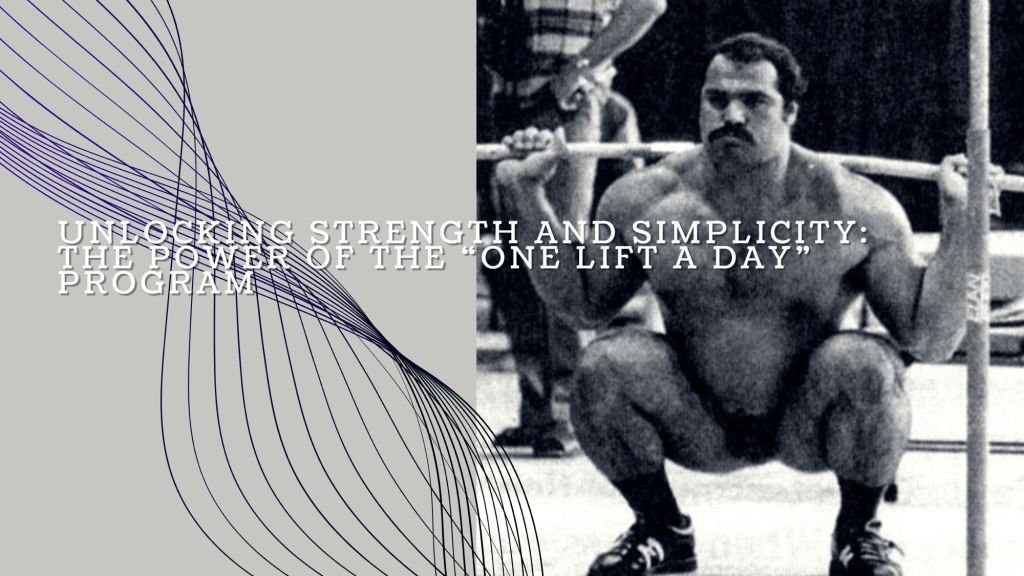
    The premise is simple: each day, you focus on just one lift. That’s right—one lift per day. This might sound too simple to be effective, but it’s precisely this simplicity that makes the program so powerful. When life gets demanding, and time is at a premium, the “One Lift a Day” approach allows you to stay consistent with your training, even when you can only carve out 15-20 minutes at a time.

    Why It Works

    The brilliance of the “One Lift a Day” program lies in its focus on Minimum Effective Dose (MED). This concept is about doing the least amount of work required to elicit a positive change in your strength and fitness levels. In a world that often equates more with better, this program flips the script by emphasizing quality over quantity. By honing in on one lift, you can give it your full attention, perfect your form, and push yourself to the limit without worrying about conserving energy for the next exercise.

    Another key advantage of this program is its adaptability. Whether you’re training in a fully equipped gym, a home gym, or even a hotel fitness center with limited options, the “One Lift a Day” program can be tailored to suit your environment. All you really need is access to a barbell, dumbbells, or even just your body weight, and you’re good to go. This makes it an excellent choice for those who travel frequently or have unpredictable schedules.

    Structuring Your “One Lift a Day” Program

    The “One Lift a Day” program typically runs over a 5-day cycle, focusing on different movement patterns each day. Here’s a sample structure:

    1. Monday: Bench Press or Incline Bench Press
      Start your week with a powerful push movement. The bench press or incline bench press targets the chest, shoulders, and triceps, making it an essential lift for upper body strength.
    2. Tuesday: Row or Row Variation
      Follow up with a pull movement like the barbell row or another row variation. This complements the push from Monday and targets the back, biceps, and rear deltoids, ensuring balanced development.
    3. Wednesday: Squat
      Midweek is dedicated to the king of all lifts—the squat. This full-body exercise primarily targets the quads, glutes, and lower back, but it also engages the core and upper body, making it indispensable for overall strength.
    4. Thursday: Off
      Take a well-deserved rest day to allow your body to recover from the intense lifting earlier in the week.
    5. Friday: Military Press
      End your workweek with the military press, focusing on shoulder strength and stability. This overhead press movement also engages the triceps and core, contributing to upper body power.
    6. Saturday (Fun Day): Curl, Deadlift, Whatever
      Saturday can be an optional “fun day” where you tackle whatever lift or exercise you feel like, whether it’s bicep curls, deadlifts, or any other movement you enjoy. This day is more flexible, allowing you to add variety or focus on any areas you want to give extra attention.

    This structure allows for a well-rounded approach to building strength, focusing on major compound lifts that engage multiple muscle groups. It also provides enough recovery time between heavy lifts, ensuring you can perform at your best each session.

    Reps and Sets Scheme

    To maximize the effectiveness of the “One Lift a Day” program, Dan John recommends a specific reps and sets scheme that evolves over the course of four weeks. Each week is designed to build on the previous one, gradually increasing intensity while managing volume to avoid burnout. Here’s how you can structure your training:

    Week One: 7 Sets of 5

    In the first week, you’ll perform seven sets of five reps for your chosen lift. This is a challenging workout, especially when performing big lifts like squats, bench presses, deadlifts, or overhead presses. To manage the intensity, Dan John suggests using a “wave” approach with your weight selection:

    • Set 1: 225 lbs for five reps
    • Set 2: 245 lbs for five reps
    • Set 3: 265 lbs for five reps
    • Set 4: 275 lbs for five reps (a tough lift, may not be able to get another set at this weight)
    • Set 5: 235 lbs for five reps (a refreshing drop in intensity)
    • Set 6: 255 lbs for five reps (a challenging but manageable set)
    • Set 7: Either 275 lbs or 285 lbs, depending on your energy and spotter availability

    For added intensity, especially with squats or bench presses, consider incorporating explosive movements immediately after your set, such as jumps for height or explosive push-ups. This combination has a powerful impact on both strength and conditioning.

    Week Two: 6 Sets of 3

    In the second week, you’ll reduce the volume to six sets of three reps. This week is designed to be about 50% of the volume of Week One, but you should aim to increase the weight slightly. The reduction in reps allows you to lift heavier while still maintaining focus and intensity.

    Week Three: 5-3-2

    Week Three introduces a 5-3-2 set and rep scheme, where the double at the end of your session is treated as a near-max effort. This week is an opportunity to push your limits while ensuring that your technique remains solid. The 5-3-2 scheme is particularly effective because it encourages you to go heavy while still maintaining control.

    Week Four: Off!

    After three weeks of progressively challenging workouts, Week Four is all about recovery. Take this week off to allow your body to fully recover and prepare for the next cycle. Although it may be tempting to skip the rest week, it’s crucial for preventing burnout and ensuring long-term progress.

    Perfect for Home Gyms and Travel

    For those with home gyms or who travel frequently, the “One Lift a Day” program is especially practical. The minimal equipment required means you don’t need to invest in a vast array of gear. A basic setup with a barbell, some weights, and a squat rack will cover almost everything you need. Even in a well-equipped hotel gym, you’ll likely find enough to complete a workout—if not, your body weight can always be used creatively. The simplicity of this program makes it ideal for maintaining consistency, no matter where you are.

    Why This Is Sufficient for Strength and Health Goals

    At first glance, the “One Lift a Day” program might seem too minimalist to address all aspects of fitness. However, its focus on heavy, compound lifts—such as squats, deadlifts, and presses—ensures that you’re working multiple muscle groups and improving your overall strength. These multi-joint exercises are incredibly effective for building muscle, which in turn increases your metabolic rate and helps you burn more calories even at rest. This shift in metabolic rate due to increased muscle mass is a key factor in long-term fat loss and weight management.

    Moreover, while the program doesn’t include traditional cardiovascular exercises, the intense nature of the lifts, particularly when performed with heavy weights and minimal rest, offers substantial cardiovascular benefits. Exercises like the back squat and deadlift require significant exertion, which elevates your heart rate and improves cardiovascular conditioning. This kind of strength training not only builds muscle but also supports heart health and enhances overall fitness.

    Conclusion

    Dan John’s “One Lift a Day” program is a testament to the power of simplicity in strength training. When life gets hectic and time becomes a precious commodity, this program offers a way to stay strong, healthy, and consistent without the need for elaborate routines or extensive time commitments. By focusing on the essentials and embracing the concept of Minimum Effective Dose, you can continue making progress even in the busiest of times. Remember, it’s not the duration, variation, or complexity of your workouts that lead to success—it’s the hard work, focus, and consistency that make all the difference.