Tag: MindfulLiving

  • The Minimalist Wheel of Life: A Simple Approach to Balance and Focus

    The Minimalist Wheel of Life: A Simple Approach to Balance and Focus

    In today’s world, we’re constantly asked to manage more — more goals, more categories, more tools to track our progress. The classic Wheel of Life method is a fantastic framework for self-reflection, but with its 8 to 12 categories, it can quickly feel overwhelming. For busy professionals, the last thing you need is another complex system that steals time instead of creating clarity.

    Minimalism offers a better way. Instead of trying to optimize every corner of life, a minimalist Wheel of Life helps you zoom in on what truly matters, giving you maximum clarity with minimum effort.

    🌐 What Is the Wheel of Life?

    The Wheel of Life is a personal development tool designed to visualize how balanced your life feels. Traditionally, you divide a circle into several segments (health, work, relationships, finances, hobbies, etc.) and rate each from 1–10. The resulting “wheel” shows where you’re rolling smoothly — or hitting bumps that throw you off course.

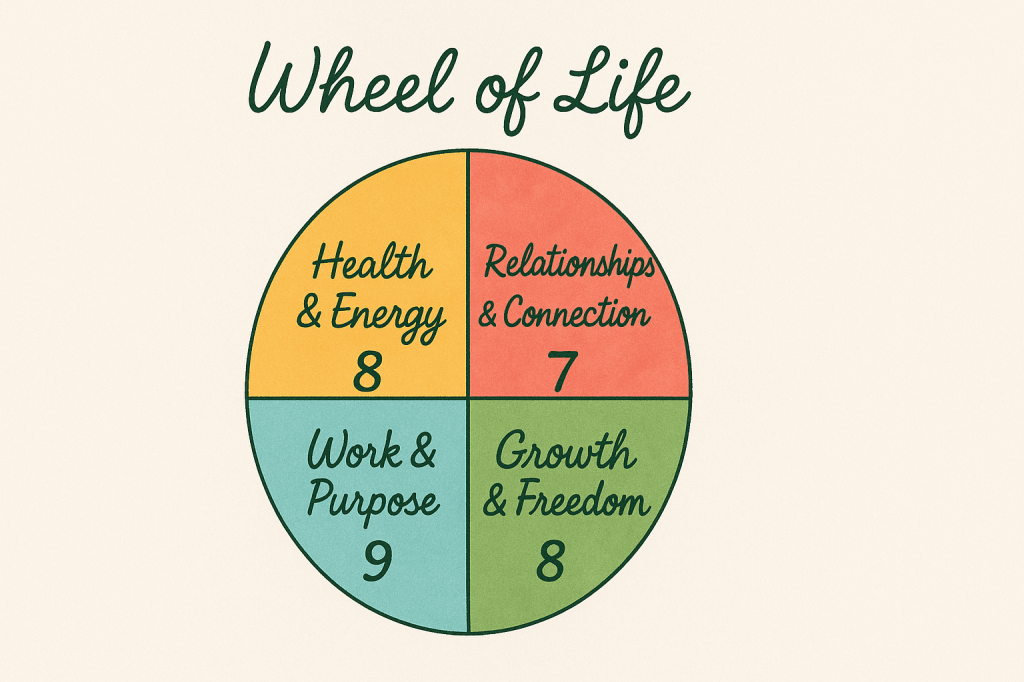
    ✨ The Minimalist Take: 4 Core Areas

    Instead of juggling 8–12 categories, this streamlined version focuses on 4 key areas that influence everything else:

    1. 💪 Health & Energy: Your physical and mental foundation. Without good health, it’s nearly impossible to sustain performance anywhere else.
    2. 🤝 Relationships & Connection: Family, friendships, and colleagues. The quality of your connections shapes the quality of your days.
    3. 🚀 Work & Purpose: Your career, projects, or mission. Work provides structure, growth, and financial security — but also meaning.
    4. 🌱 Growth & Freedom: Personal growth, learning, hobbies, spirituality, and financial independence. These ensure you’re not just surviving but also expanding.

    With these four, you strip away the noise yet still capture the essence of a well-rounded life.

    🕒 How and When to Do It

    • Quarterly check-in: Once every three months is enough. Life doesn’t shift overnight, but this rhythm keeps you aligned.
    • Rate simply: Give each area a score from 1–10. No need for fancy visuals — four numbers on paper (or in your notes app) are enough.
    • Choose one focus: Instead of chasing improvement everywhere, ask: Which area, if improved, would create the biggest ripple effect?

    💡 Example: Getting consistent sleep and exercise (Health & Energy) will often boost your focus at work, patience at home, and motivation for growth.

    ⚖️ Why Balance Isn’t the Goal

    Here’s the key: life won’t always be balanced — and that’s okay. Sometimes one area will dominate your focus so you can make real progress. Maybe you’re pushing hard on a career project 🚀, or focusing on your health after a rough season 💪.

    The point isn’t to keep every category at a perfect 10 at all times. It’s about being aware, making intentional trade-offs, and then realigning when the time is right. Balance is dynamic, not static.

    🌟 Benefits of the Minimalist Wheel of Life

    • Clarity without overwhelm – Four categories are easy to reflect on.
    • Maximum leverage – Progress in one area cascades into the others.
    • Quick practice – Less than 10 minutes per quarter keeps it sustainable.
    • Intentional focus – Helps you decide where to lean in and where to accept “good enough.”

    Final Thought

    Minimalism isn’t about doing less for the sake of it. It’s about removing distractions so the essentials shine. The minimalist Wheel of Life does just that: it simplifies reflection, highlights your priorities, and gives you the clarity to act with purpose.

    Because in the end, life isn’t about juggling every category perfectly — it’s about knowing where to focus now, so you can move forward with balance in the long run. 🌿
  • ✅ The Rule of Three: Simplifying Your Daily Goals for Maximum Impact

    ✅ The Rule of Three: Simplifying Your Daily Goals for Maximum Impact

    🧠 You start your day with a long to-do list.

    It’s packed with tasks, ideas, emails, and reminders. By noon, you’re “busy”… but not productive.

    Sound familiar?

    Let me offer you something simpler—and far more powerful:

    🎯 The Rule of Three.

    It’s a minimalist productivity method I use daily, and it’s changed how I work, lead, and live.

    🔍 What is the Rule of Three?

    Each morning, ask yourself:

    💬 “What are the 3 most important things I want to accomplish today?”

    Not 10.

    Not everything.

    Just 3.

    These should be high-impact actions—not shallow tasks. Think: finish a proposal, prep for a meeting, finalize a decision.

    🎯 The work that truly moves the needle.

    🧠 Why It Works:

    ✔️ Focus over friction – You eliminate decision fatigue.

    ✔️ Clarity beats chaos – Your day has a compass, not a pile of noise.

    ✔️ Progress feels real – Checking off 3 important wins builds momentum and motivation.

    Studies show that multitasking can reduce productivity by up to 40%. The Rule of Three creates space for deep work instead of distraction.

    ⚙️ How to Use It:

    📅 Every morning, take 2 minutes.

    Write down your 3 priorities—paper, app, mirror—it doesn’t matter.

    Just do it before opening your inbox or calendar.

    🏡 Apply it across life areas:

    Work: finish project draft Health: 20-minute workout Family: tech-free dinner time

    Need more structure? Use this question:

    💡 “What 3 things would make today feel successful—even if I got nothing else done?”

    Stick to 3. If you’re tempted to add more, make it a bonus. 🎁

    🌱 Bonus: The Weekly Rule of Three

    Take 5 minutes every Sunday:

    What’s 1 major work goal? What’s 1 health or personal goal? What’s 1 relationship or family goal?

    Write them down. Keep them visible. Reflect midweek. 🧭

    ✳️ Minimalism in Action

    The Rule of Three isn’t about doing less.

    It’s about doing what matters most—with clarity and consistency.

    “Essentialism isn’t how to get more things done. It’s how to get the right things done.”

    – Greg McKeown

    🎯 When you simplify your focus, you amplify your results.

    🚀 Try This Tomorrow

    ✅ Write down 3 priorities

    ✅ Tackle them before distractions

    ✅ Track how it feels over 1 week

    👇 Drop one of your 3 below if you’re in.

    Let’s make simplicity your new superpower.

  • The Impact of Digital Detox on Productivity: How Unplugging Supercharges Your Focus

    The Impact of Digital Detox on Productivity: How Unplugging Supercharges Your Focus

    In a world where screens dominate our attention, it’s hard to imagine a day without constant pings, notifications, and endless scrolling. Yet, while technology has undoubtedly made our lives more efficient, it’s also pulled us into a productivity paradox. Constant digital connection leaves us mentally drained, distracted, and overwhelmed. Sound familiar? You’re not alone.

    What if the key to doing more lies in unplugging more? Enter the concept of a digital detox — an intentional break from screens and technology to reset your mind and reclaim your focus. Research and real-world examples show that stepping away can help you think sharper, reduce stress, and ultimately, supercharge your productivity.

    Ready to find out how? Let’s explore why a digital detox works, how it benefits you, and practical ways to make it happen.


    Why Do We Need a Digital Detox?

    We live in a time where being constantly plugged in is often seen as a badge of honor. But here’s the truth: perpetual screen time isn’t sustainable. Here’s why a digital detox has become more necessary than ever:

    1. Digital Fatigue: Staring at screens all day can lead to eye strain, headaches, and mental exhaustion.
    2. Reduced Focus: Constant notifications and app-switching fragment your attention, making deep work nearly impossible.
    3. Burnout: Without downtime, your brain stays in overdrive, leading to higher stress and lower energy levels.
    4. Creativity Block: Too much screen time hampers the brain’s ability to wander and innovate, both of which are crucial for problem-solving.

    A shocking statistic? Research shows that employees spend 2.5 hours every day recovering from digital distractions. That’s valuable time you could be using to make real progress.


    The Science Behind Screen Breaks and Improved Productivity

    What happens to your brain when you unplug? Let’s get into the science:

    • Mental Reset: Taking a break from screens allows your prefrontal cortex (the brain’s command center) to recharge, which improves decision-making and problem-solving.
    • Increased Focus: Without constant digital interruptions, your brain enters a state of deep work — a flow where productivity skyrockets.
    • Better Memory: Studies show that overexposure to screens decreases retention. A digital detox allows you to absorb information more effectively.
    • Stress Reduction: Stepping away from digital overstimulation lowers cortisol levels, helping you feel calmer and more centered.

    Simply put, your brain needs breaks to perform at its best. Think of it like working out at the gym: rest days are essential for muscle recovery and growth. The same is true for your mental fitness.


    Practical Steps to Start a Digital Detox

    Okay, so unplugging sounds great… but how do you make it a reality, especially when your work depends on screens? Start small and make it manageable with these practical steps:

    1. Schedule Tech-Free Times
    • Set aside 1-2 hours each day where you put your phone and laptop away.
    • Try a morning or evening ritual: No screens for the first 30 minutes after waking up or the last hour before bed.
    2. Create Tech-Free Zones
    • Designate certain spaces (like the dining table or bedroom) as no-device zones. This creates natural breaks during your day.
    3. Batch Your Screen Time
    • Limit mindless scrolling and email-checking to specific times of the day.
    • For example: Check emails twice a day (once in the morning and once before wrapping up).
    4. Use Tools to Help You Unplug
    • Apps like Freedom, Forest, or Stay Focused block distractions and encourage screen-free time.
    • Switch to airplane mode during deep work sessions.
    5. Replace Screens with Productive Alternatives
    • Read a book, journal your thoughts, or take a walk to reset your mind.
    • Replace endless scrolling with activities that inspire creativity, like doodling or brainstorming ideas on paper.

    Pro Tip: Start small. Even a 10-15 minute break from screens can help you recharge and return to work with sharper focus.


    Real-Life Benefits of Digital Detox

    Still skeptical? Here’s how a digital detox can positively impact your life:

    • Improved Focus: Professionals who take regular screen breaks report getting more done in less time.
    • Increased Creativity: Stepping away gives your brain space to think freely, leading to innovative ideas.
    • Reduced Burnout: Disconnecting lowers stress, boosts energy, and prevents mental fatigue.
    • Better Work-Life Balance: Tech-free moments help you feel more present with family, friends, and yourself.

    Many successful leaders swear by screen breaks. For instance, the late Steve Jobs was known to take long walks to clear his mind and strategize. Similarly, many CEOs schedule tech-free mornings for reflection and focus.


    Overcoming Common Challenges

    Thinking, “I can’t unplug because my work depends on technology”? You’re not alone. Here’s how to tackle common barriers:

    1. “I need to be available 24/7.”
      • Set boundaries and communicate them. Let colleagues know you’ll respond during specific hours.
    2. “I’ll miss something important.”
      • Prioritize what truly needs your attention. Most notifications aren’t urgent.
    3. “Unplugging feels unproductive.”
      • Remember: Rest is part of productivity. A refreshed mind performs better.

    Productivity Beyond the Screen

    In our hyperconnected world, it’s easy to believe that constant availability equals success. But true productivity comes from focus, clarity, and energy—all of which suffer when we’re glued to screens.

    A digital detox isn’t about abandoning technology; it’s about using it more intentionally. By taking regular breaks, you give yourself the mental space to recharge, think clearly, and ultimately achieve more.

    Your Challenge: Unplug for one hour today. Put your phone on silent, close your laptop, and step away. Use this time to reflect, recharge, or do something screen-free. You might just discover that less screen time leads to more progress.

    Your brain (and your productivity) will thank you.

  • Embrace Minimalist Living: A Guide to Downsizing and Thriving in a Smaller Space

    Embrace Minimalist Living: A Guide to Downsizing and Thriving in a Smaller Space

    A Path to Simplicity and Joy

    In a world increasingly filled with clutter and chaos, many people are discovering the transformative power of minimalist living. Picture this: a serene, decluttered space where each item has purpose and meaning. According to a survey by the National Association of Professional Organizers, 82% of people feel more stressed when surrounded by clutter. This statistic highlights the necessity for change. Embracing a minimalist lifestyle not only simplifies your surroundings but can also lead to a more fulfilling and intentional life. Let’s explore how to downsize and thrive in a smaller space.

    Understanding Minimalism

    Minimalism is more than just a design aesthetic; it’s a way of life that encourages individuals to focus on what truly matters. At its core, minimalism is about intentionality—prioritizing experiences and relationships over material possessions. By stripping away excess, you can create space for what genuinely brings you joy and fulfillment. The benefits are manifold: reduced stress, improved financial health, and a lighter ecological footprint. Imagine living in a space that feels expansive, not constricting; where every item serves a purpose, and your mind is free to wander without the weight of unnecessary belongings.

    Assessing Your Current Space

    The first step toward minimalism is a thorough evaluation of your current belongings. Begin by walking through each room and making a mental note of what you truly need versus what merely occupies space. Ask yourself critical questions: “When was the last time I used this?” or “Does this item bring me joy?” It can be helpful to visualize your ideal living space—how would it look and feel? This assessment will serve as a foundation for your decluttering journey.

    Steps to Downsize Your Possessions

    Now comes the most challenging yet rewarding part: downsizing. Here are practical strategies to help you on this journey:

    • The One-Year Rule: If you haven’t used an item in the past year, it’s likely time to let it go. This rule helps you identify what you can part with without sentimentality clouding your judgment.
    • The Marie Kondo Method: Inspired by Marie Kondo’s book The Life-Changing Magic of Tidying Up, this method encourages you to hold each item and ask yourself, “Does this spark joy?” If it doesn’t, it may be time to say goodbye.
    • Digital Decluttering: Don’t forget your digital space! Organize your files, unsubscribe from unwanted emails, and remove apps that no longer serve you. A streamlined digital environment can significantly reduce mental clutter.
    • Resources for Selling or Donating: Consider selling items online through platforms like eBay or Facebook Marketplace, or donate to local charities. This not only clears space but can also help those in need.
    Designing a Smaller Space

    Once you’ve downsized, it’s time to design your smaller space effectively. Maximizing space doesn’t mean sacrificing style. Here are some tips:

    • Multifunctional Furniture: Invest in furniture that serves multiple purposes, such as a coffee table that doubles as storage or a sofa bed for guests. This reduces clutter while enhancing functionality.
    • Vertical Storage: Utilize vertical space by installing shelves or hanging storage solutions. This draws the eye upward and creates an illusion of a larger room.
    • Creating a Minimalist Aesthetic: Use a cohesive color palette and limit decor items to those that bring joy or serve a purpose. A few well-chosen pieces can have a more profound impact than a multitude of trinkets.
    Maintaining a Minimalist Lifestyle

    Transitioning to a minimalist lifestyle requires a mindset shift. Here are strategies to maintain this new way of living:

    • Mindset Shifts: Focus on quality over quantity. Invest in well-made items that will last rather than frequent purchases of cheaper goods. This reduces waste and fosters a deeper appreciation for what you own.
    • Avoiding Future Clutter: Practice the “one in, one out” rule. For every new item you bring into your home, let go of one you no longer need. This helps maintain balance and prevents accumulation.
    Thriving in Your Smaller Space

    Living in a smaller space doesn’t mean compromising on comfort or enjoyment. In fact, minimalism can enhance your lifestyle:

    • Creating a Peaceful Environment: A decluttered space fosters tranquility. Consider incorporating plants, natural light, and calming colors to enhance the ambiance of your home.
    • Prioritizing Experiences Over Possessions: With fewer material distractions, you can focus on what truly matters—experiences. Whether it’s traveling, exploring new hobbies, or spending quality time with loved ones, a minimalist lifestyle can enrich your life.
    The Lasting Benefits of Embracing Minimalism

    Embracing minimalist living is a powerful way to create a life filled with intention, clarity, and peace. By downsizing and thriving in a smaller space, you open the door to a more fulfilling existence. Remember, minimalism isn’t about deprivation; it’s about freedom—freedom from clutter, stress, and the relentless pursuit of more.

    Call to Action

    Are you ready to embark on your minimalist journey? Share your experiences or tips in the comments below! Together, we can inspire one another to embrace a simpler, more meaningful life.