Tag: minimalism

  • The Minimalist Wheel of Life: A Simple Approach to Balance and Focus

    The Minimalist Wheel of Life: A Simple Approach to Balance and Focus

    In today’s world, we’re constantly asked to manage more — more goals, more categories, more tools to track our progress. The classic Wheel of Life method is a fantastic framework for self-reflection, but with its 8 to 12 categories, it can quickly feel overwhelming. For busy professionals, the last thing you need is another complex system that steals time instead of creating clarity.

    Minimalism offers a better way. Instead of trying to optimize every corner of life, a minimalist Wheel of Life helps you zoom in on what truly matters, giving you maximum clarity with minimum effort.

    🌐 What Is the Wheel of Life?

    The Wheel of Life is a personal development tool designed to visualize how balanced your life feels. Traditionally, you divide a circle into several segments (health, work, relationships, finances, hobbies, etc.) and rate each from 1–10. The resulting “wheel” shows where you’re rolling smoothly — or hitting bumps that throw you off course.

    ✨ The Minimalist Take: 4 Core Areas

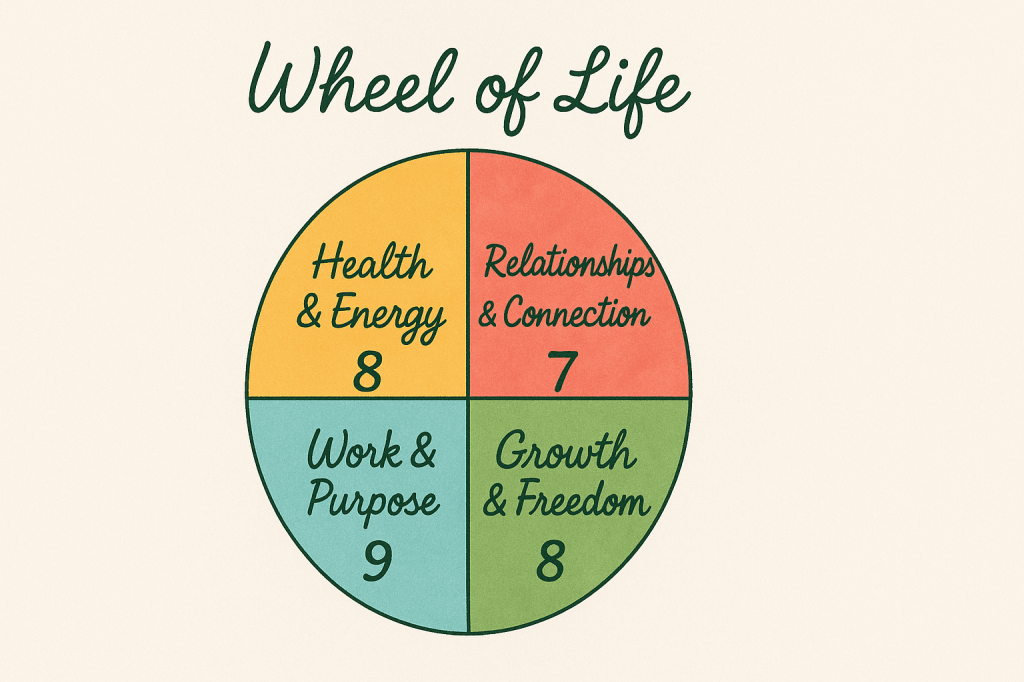
    Instead of juggling 8–12 categories, this streamlined version focuses on 4 key areas that influence everything else:

    1. 💪 Health & Energy: Your physical and mental foundation. Without good health, it’s nearly impossible to sustain performance anywhere else.
    2. 🤝 Relationships & Connection: Family, friendships, and colleagues. The quality of your connections shapes the quality of your days.
    3. 🚀 Work & Purpose: Your career, projects, or mission. Work provides structure, growth, and financial security — but also meaning.
    4. 🌱 Growth & Freedom: Personal growth, learning, hobbies, spirituality, and financial independence. These ensure you’re not just surviving but also expanding.

    With these four, you strip away the noise yet still capture the essence of a well-rounded life.

    🕒 How and When to Do It

    • Quarterly check-in: Once every three months is enough. Life doesn’t shift overnight, but this rhythm keeps you aligned.
    • Rate simply: Give each area a score from 1–10. No need for fancy visuals — four numbers on paper (or in your notes app) are enough.
    • Choose one focus: Instead of chasing improvement everywhere, ask: Which area, if improved, would create the biggest ripple effect?

    💡 Example: Getting consistent sleep and exercise (Health & Energy) will often boost your focus at work, patience at home, and motivation for growth.

    ⚖️ Why Balance Isn’t the Goal

    Here’s the key: life won’t always be balanced — and that’s okay. Sometimes one area will dominate your focus so you can make real progress. Maybe you’re pushing hard on a career project 🚀, or focusing on your health after a rough season 💪.

    The point isn’t to keep every category at a perfect 10 at all times. It’s about being aware, making intentional trade-offs, and then realigning when the time is right. Balance is dynamic, not static.

    🌟 Benefits of the Minimalist Wheel of Life

    • Clarity without overwhelm – Four categories are easy to reflect on.
    • Maximum leverage – Progress in one area cascades into the others.
    • Quick practice – Less than 10 minutes per quarter keeps it sustainable.
    • Intentional focus – Helps you decide where to lean in and where to accept “good enough.”

    Final Thought

    Minimalism isn’t about doing less for the sake of it. It’s about removing distractions so the essentials shine. The minimalist Wheel of Life does just that: it simplifies reflection, highlights your priorities, and gives you the clarity to act with purpose.

    Because in the end, life isn’t about juggling every category perfectly — it’s about knowing where to focus now, so you can move forward with balance in the long run. 🌿
  • Every Yes is a No: The Hidden Cost of Your Commitments

    Every Yes is a No: The Hidden Cost of Your Commitments

    “Every ‘yes’ is a ‘no’ to something else. Choose wisely.”

    In today’s knowledge work environment, where our days are filled with meetings, emails, and endless requests, this quote couldn’t be more relevant. Each decision we make isn’t just an acceptance—it’s also a refusal. The problem is, most of us forget to see the hidden cost behind every commitment.

    1. The Hidden Cost of Yes 💸

    Every “yes” has an opportunity cost. Agreeing to one more meeting might mean losing the two hours you had set aside for deep, strategic work. Saying yes to a small favor might mean saying no to finishing a project that actually moves your career forward.

    2. Why Focus Suffers Without Boundaries 🎯

    Focus is a finite resource. When you scatter it across too many low-value commitments, your ability to deliver high-quality results drops. Busyness creates the illusion of productivity, but in reality, fragmented attention kills creativity and effectiveness.

    3. The Power of a Strategic No ✋

    Here’s the shift: saying “no” is not rejection—it’s protection. By turning down distractions, you’re saying yes to what truly matters:

    • 🧠 Deep work and clarity
    • 📊 Strategic priorities
    • 🧘 Personal well-being

    A well-placed “no” is often the most productive choice you can make.

    4. Practical Applications 🛠️

    How do you apply this mindset in your day-to-day? A few ideas:

    • Pause before committing – Don’t rush your yes.
    • Align with your goals – Ask: Does this move me closer to what matters?
    • Refuse gracefully – “I’d love to help, but I can’t give this the focus it deserves right now.”
    • Protect focus time – Block your calendar for your most important work.

    5. Conclusion / Takeaway 🌟

    Every time you say yes, you’re automatically saying no to something else. The difference between busy professionals and truly effective ones lies in choosing wisely.

    Remember: your time and attention are not infinite. Treat them as investments, not giveaways. When you protect your “yes,” you create the space to produce meaningful results—and to live with more clarity and purpose.

    👉 What’s the last thing you said yes to—and what did you unknowingly say no to in the process?

  • Efficiency Begins Where Overthinking Ends 🚀

    Efficiency Begins Where Overthinking Ends 🚀

    Every minute spent second-guessing is a minute not spent doing.

    Overthinking feels productive — all those mental scenarios, pros-and-cons lists, and “just one more bit of research” moments. But in reality, it’s a thief of time, energy, and momentum.

    Here’s the truth: Efficiency doesn’t come from thinking more. It comes from thinking just enough to take the next step.

    The Problem: How Overthinking Kills Efficiency 🛑

    Overthinking isn’t deep thinking. It’s mental looping:

    🤯 Decision paralysis – The more you think, the harder it becomes to choose.

    🕰 Loss of momentum – Time passes, but progress doesn’t.

    😩 Mental fatigue – You’re tired before you’ve even begun.

    📉 Missed opportunities – While you’re stuck deciding, someone else is already doing.

    Picture this: the report you keep revising “just in case” or the fitness plan you research for weeks but never start. Sound familiar?

    Why Action Beats Endless Analysis ⚡

    Clarity often comes from doing, not from thinking more. The first draft, the first meeting, the first rep in the gym — they teach you more than any hypothetical ever could.

    The world’s best leaders, athletes, and entrepreneurs share a secret: decisive action, followed by fast adjustments, beats perfect planning every time.

    5 Practical Strategies to Stop Overthinking Today 🛠

    1️⃣ Set Decision Boundaries

    Give yourself a limit: “I’ll decide within 24 hours” or “After gathering 3 key facts, I move forward.”

    2️⃣ Apply the 80/20 Rule

    Identify the 20% of actions that bring 80% of results — and start there.

    3️⃣ Limit Your Options

    Fewer choices = faster decisions. Don’t compare 12 solutions; compare 2.

    4️⃣ Trust Small Experiments

    Run quick, low-risk tests instead of betting everything on one big move.

    5️⃣ Establish a “Do First” Habit

    Take one step forward immediately, then refine later. Progress > perfection.

    Mindset Shifts for Long-Term Change 🧠

    Progress over perfection – Perfect is an illusion. Mistakes = Feedback – Each misstep sharpens your approach. No decision is still a decision – And usually, it’s the worst one.

    The Bottom Line ✅

    True efficiency starts the moment you stop spinning in your head and start moving your feet.

    Think less. Do more. Let momentum carry you further than perfection ever could.

    💡 Try this today: Pick one decision you’ve been overthinking, set a 10-minute timer, and act before it runs out. You’ll be amazed how liberating it feels.

  • Simplicity reveals what truly matters.

    Simplicity reveals what truly matters.

    In today’s fast-paced project environments, complexity has become the default. We pile on tools, processes, reports, and meetings — hoping to gain control, but often ending up with noise.

    The result?

    Slower progress, unclear priorities, and teams spread thin trying to do everything at once.

    But here’s the truth: complexity is often the enemy of execution.

    In project management and productivity, simplicity isn’t just aesthetic — it’s a strategic advantage. It clears the path for meaningful outcomes and helps teams focus on what actually moves the needle.

    Here’s how to make it real:

    🔹 1. Clarify before you plan.

    Before drafting a timeline or task list, distill the “why” behind the project. If the objective can’t be stated in one sentence, it’s not yet clear enough. Clarity saves you from scope creep later.

    🔹 2. Use fewer tools, better.

    Too many apps create silos and friction. Choose one project management platform — and build a shared, standardized workflow. A good tool used consistently beats a dozen half-integrated ones.

    🔹 3. Replace zombie meetings with async updates.

    Audit recurring meetings monthly. If there’s no new decision to make or problem to solve, it doesn’t need to be a meeting. Tools like dashboards, shared docs, or Loom updates can deliver the same value in half the time.

    🔹 4. Prioritize visually.

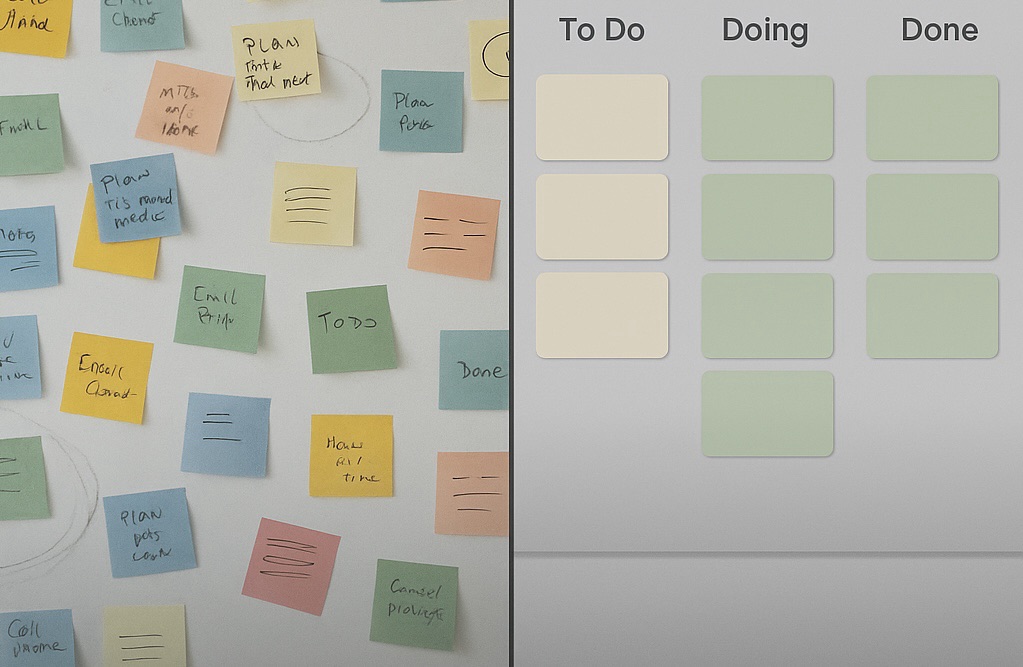
    A Kanban board, a visual timeline, or even a simple progress bar communicates faster than a 10-slide deck. Simplicity isn’t dumbing down — it’s speeding up understanding.

    🔹 5. Focus on one high-impact outcome at a time.

    Multitasking scatters attention. Sequence your team’s work around clear milestones, and make sure everyone knows the current priority. Simplicity helps people feel progress — and progress drives engagement.

    Why this matters:

    Simplicity improves decision-making.

    It reduces stress.

    It accelerates delivery.

    When you eliminate the unnecessary, you uncover what truly drives value — and give your team room to breathe, focus, and thrive.

    In leadership, simplicity is contagious. A streamlined process or a clear, concise brief sets the tone for execution with purpose.

    If your project workflow feels heavy, pause and ask:

    “What can I remove that no longer serves the goal?”

    Sometimes progress means doing less, but doing it better.

    Simplicity reveals what truly matters.

    🔄 Your turn:

    What’s one process, tool, or meeting you’ve simplified recently — and what impact did it have?

    👇 Share below and let’s build smarter, leaner projects together.

  • 💳 “Subscription Detox” – Save Money, Clear Your Mind, Take Back Control

    💳 “Subscription Detox” – Save Money, Clear Your Mind, Take Back Control

    You know the drill:

    Free trial.

    Then €4.99/month.

    Then €14.99.

    Then suddenly you’re subscribed to seven streaming services, three productivity apps, two meditation platforms (that stress you out with daily reminders), and a magazine you haven’t read since 2022.

    But hey, it’s only a few bucks a month, right?

    Wrong.

    👉 In my recent “Subscription Detox,” I audited all recurring charges tied to my accounts.

    The results? Eye-opening:

    💸 Over €950/year wasted on unused or rarely used subscriptions.

    🧠 Countless moments of mental clutter—email spam, notification fatigue, decision fatigue from “which platform to watch/read/meditate on today?”

    We don’t talk enough about the hidden tax of convenience.

    Modern life is a buffet of bite-sized services. Everything is just a tap away. We subscribe to convenience, to potential, to aspiration.

    But here’s the trap:

    You’re not just spending money.

    You’re spending mental bandwidth maintaining relationships with tools you don’t even use.

    Every “free trial” comes with a silent cost:

    🔔 Another notification.

    📧 Another email.

    🧾 Another charge on your statement.

    And eventually…

    ⏳ Another minute wasted figuring out if you should cancel.

    So I made it simple. Here’s how I detoxed:

    1. Export your bank statement.

    Sort for recurring monthly and yearly charges. Highlight the ones you don’t recognize or haven’t used in 30+ days.

    2. Rank subscriptions by ROI.

    Does it truly add value? Save time? Bring joy? Or is it just there because you forgot to cancel after the trial?

    3. Ruthlessly cancel.

    Even if it feels small. Even if it might “one day” be useful. Future-you will thank you.

    4. Reinvest in freedom.

    Fewer subscriptions = fewer decisions = more clarity.

    After my detox, I felt like I had deleted 17 tabs open in my mind.

    Now, my money goes where my attention actually lives.

    🎯 A focused Spotify plan I use daily.

    🎯 A minimalist calendar app that brings me clarity.

    🎯 Zero guilt about not using the rest.

    It’s not just about saving €80/month.

    It’s about reclaiming your attention.

    💡 Because in a world constantly shouting for your subscription, sometimes the most powerful thing you can do… is unsubscribe.

    📌 Your turn:

    Do a “Subscription Detox” this weekend.

    Audit, cancel, and take back control.

    Then share your number:

    💬 How many subscriptions did you cancel?

    Let’s inspire each other to live with intention, not automation.

    🧘‍♂️ Less clutter.

    💰 More savings.

    🧠 Maximum clarity.

    You in?