
Introduction to Efficiency
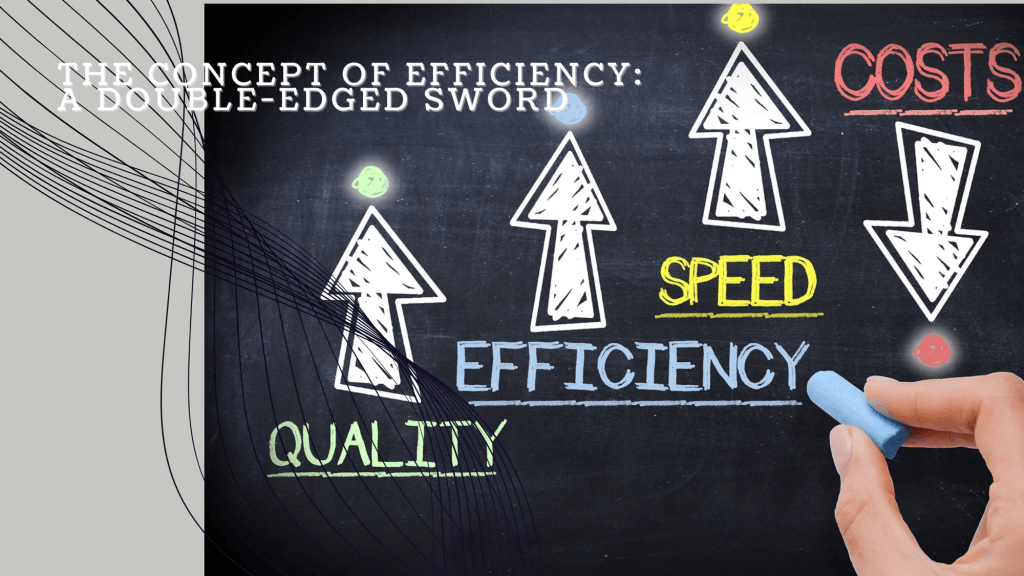
Efficiency, at its core, is the ability to achieve a desired outcome with the least amount of wasted time, effort, or resources. It is a measure of how well inputs are converted into outputs, often expressed as a ratio of output to input. In a highly efficient system, more is produced with less, leading to faster, cheaper, or more sustainable results. This concept permeates various aspects of life, from personal time management to the operations of complex organizations and even entire economies.
The allure of efficiency is clear: it promises increased productivity, reduced costs, and the ability to do more with less. However, as with many powerful concepts, the pursuit of efficiency is not without its drawbacks. A closer examination reveals that while efficiency can yield significant benefits, an overemphasis on it can lead to unintended consequences, particularly when systems become too streamlined and lose their resilience to external and internal disruptions.
High and Low Efficiency: Examples in Practice
High efficiency can be seen in industries that have successfully optimized their processes to reduce waste and maximize output. For instance, Toyota’s production system is a classic example of high efficiency. The company’s adoption of Just-In-Time (JIT) manufacturing, which produces goods only as they are needed, significantly reduced inventory costs and increased production speed. This approach allowed Toyota to dominate the automotive industry by offering reliable, affordable vehicles with minimal production waste.
On the other end of the spectrum, consider a traditional, artisanal approach to manufacturing, such as handmade furniture production. While the quality and uniqueness of each piece may be high, the process is inherently inefficient by modern standards. Each piece requires significant time, skilled labor, and materials, which results in higher costs and longer production times. Although this low-efficiency process might produce superior craftsmanship, it is not scalable or sustainable in a mass-market economy.
Society’s Obsession with Optimizing Efficiency
The relentless drive for efficiency has become a defining feature of modern society. This obsession can be traced back to the Industrial Revolution, which introduced the idea that human labor and material resources should be optimized to produce more goods at lower costs. Over time, this notion has permeated every facet of society, from business practices to personal productivity.
One reason for this obsession is the economic principle of competitive advantage. Companies that can produce goods or deliver services more efficiently than their competitors can offer lower prices, capture larger market shares, and generate higher profits. In the global economy, where competition is fierce, efficiency is often the key to survival.
Technological advancements have further fueled the drive for efficiency. Automation, artificial intelligence, and data analytics have provided tools to streamline processes and eliminate inefficiencies at unprecedented scales. The result is a society where faster, cheaper, and more efficient are often synonymous with better.
However, this relentless pursuit is not without its downsides. The drive for efficiency often leads to the elimination of redundancies, which, while seemingly wasteful, can serve as critical safety nets when systems face unexpected disruptions.
Upsides of Increased Efficiency
The benefits of increased efficiency are undeniable. In manufacturing, higher efficiency leads to lower production costs, which can translate to lower prices for consumers. The ability to produce more with less also conserves resources, which is crucial in a world with finite natural resources.
In the energy sector, for example, increasing the efficiency of power plants and appliances can significantly reduce energy consumption and greenhouse gas emissions. A more efficient power grid can deliver electricity more reliably and at lower costs, contributing to both economic and environmental goals.
Efficiency also plays a vital role in healthcare. Streamlined hospital operations can reduce patient wait times, lower healthcare costs, and improve patient outcomes. The adoption of electronic health records (EHRs) has enhanced the efficiency of medical information management, allowing for quicker and more accurate diagnoses and treatment plans.
In transportation, efficiency improvements have led to the development of fuel-efficient vehicles, reducing fuel costs and emissions. Public transportation systems that operate efficiently can reduce traffic congestion, lower pollution levels, and provide affordable transportation options to the public.
The Fragility of Over-Efficient Systems
While efficiency brings numerous benefits, systems that are overly optimized can become dangerously fragile. The elimination of redundancies and buffers, which are often seen as wasteful, can leave systems vulnerable to disruptions.
The 2008 financial crisis serves as a stark example of this fragility. The global financial system had become highly efficient, with complex financial products and high levels of leverage maximizing returns. However, this efficiency came at the cost of stability. When the housing market collapsed, the lack of adequate safeguards led to a cascading failure that nearly brought down the entire financial system.
Similarly, Just-In-Time manufacturing, while highly efficient under normal circumstances, can be extremely vulnerable to supply chain disruptions. The COVID-19 pandemic exposed these vulnerabilities when global supply chains ground to a halt, leading to shortages of essential goods, from medical supplies to semiconductors.
In nature, too, we see the consequences of over-efficiency. Monoculture farming, which involves planting large expanses of a single crop, is highly efficient in terms of production. However, it is also highly vulnerable to pests and diseases, which can wipe out entire crops due to the lack of biodiversity. In contrast, traditional farming methods that incorporate a variety of crops may be less efficient but are far more resilient to such threats.
The Fine Line Between Efficiency and Resilience
The pursuit of efficiency is a double-edged sword. While it can lead to significant benefits, there is a fine line beyond which additional efficiency gains result in diminishing returns and increased risks. Systems that are too efficient often lack the flexibility and resilience needed to adapt to unforeseen challenges.
The key to balancing efficiency with resilience lies in understanding that some level of redundancy and slack is not just acceptable but necessary. Redundancies act as shock absorbers, allowing systems to withstand and recover from disruptions. This concept is well understood in engineering, where systems are designed with safety margins to prevent catastrophic failure.
In business, too, there is a growing recognition of the importance of resilience. Companies are increasingly investing in risk management and contingency planning, recognizing that the short-term gains of extreme efficiency are often outweighed by the long-term risks.
In personal productivity, this balance is also critical. While it is tempting to maximize every minute of the day, this can lead to burnout and decreased effectiveness over time. Allowing for downtime, reflection, and unstructured time can enhance creativity and overall well-being, leading to more sustainable productivity.
Conclusion
Efficiency is a powerful concept that has driven much of the progress in modern society. It has led to remarkable advancements in technology, industry, and quality of life. However, the pursuit of efficiency must be tempered with an understanding of its limitations. Overly efficient systems, while highly productive, can become fragile and vulnerable to disruption.
The challenge lies in finding the right balance between efficiency and resilience. While it is important to eliminate waste and streamline processes, it is equally important to maintain flexibility, redundancy, and the ability to adapt to change. In the end, the most successful systems are those that achieve a harmonious balance, maximizing efficiency while safeguarding against the inherent risks of over-optimization.
 Sebastian Strobl