
Introduction
Project management has evolved over the decades into a refined discipline, integrating complex methodologies that enable the efficient planning, execution, and completion of projects. One of the foundational methodologies in this field is the Critical Path Method (CPM). This article delves into the origins of CPM, its historical context, and its impact on project management. We will explore how it is taught in contemporary academic settings, provide a detailed explanation of its methodology, and discuss its evolution into the Critical Chain Method (CCM). Finally, we will offer practical advice on how to implement these methods effectively in various types of projects.
Origins and Development of the Critical Path Method
Remington Rand and Morgan R. Walker of DuPont. The genesis of CPM can be traced to the need for more efficient project management techniques during a time of rapid industrial growth in the United States. The method was initially created to address the scheduling challenges in large, complex projects, particularly in the construction and defense industries.
James E. Kelley was an engineer and computer scientist who played a significant role in the development of project scheduling techniques. He was instrumental in applying mathematical models to project management, which laid the groundwork for the development of CPM. Morgan R. Walker, on the other hand, was a project engineer at DuPont, where he was involved in developing techniques to streamline production processes. Their collaboration led to the formalization of CPM, which quickly gained traction in industries requiring rigorous scheduling and resource management.
Notable Applications:
- Polaris Missile Project (1960s): One of the most famous early applications of CPM was in the U.S. Navy’s Polaris missile project. The method helped manage the project’s complexity, involving numerous contractors and schedules, leading to its successful completion ahead of schedule.
- Construction of the World Trade Center (1970s): The construction of the World Trade Center in New York utilized CPM to coordinate the numerous contractors and tasks, ensuring that the project remained on schedule.
The Critical Path Method in Modern Education
Today, CPM is a staple in the curriculum of business schools and engineering programs. It is typically taught as part of project management courses, where students learn how to plan, schedule, and control projects using CPM. The method’s emphasis on identifying the longest sequence of dependent tasks (the critical path) that determines the project’s minimum completion time is a fundamental concept that students must grasp.
Educational programs often integrate CPM with software tools like Microsoft Project or Primavera P6, allowing students to visualize and manage project schedules effectively. Case studies are commonly used to illustrate how CPM is applied in real-world scenarios, reinforcing the importance of this method in modern project management.
Detailed Explanation of the Critical Path Method
What is the Critical Path? The critical path is the longest sequence of tasks in a project that must be completed on time for the project to be completed by its deadline. This path determines the shortest possible project duration. If any task on the critical path is delayed, the entire project will be delayed.
Steps to Identify and Visualize the Critical Path:
- Break Down the Project into Tasks: List all the tasks required to complete the project. Each task should have a clear beginning and end.
- Identify Dependencies: Determine which tasks depend on the completion of others. These dependencies will help in identifying the sequence of tasks.
- Estimate Duration: Assign an estimated duration to each task, typically in days or weeks.
- Draw the Network Diagram: Create a visual representation of the tasks and their dependencies. This can be done using arrows or lines to connect tasks in the sequence they need to be completed.
- Determine the Longest Path: The critical path is the longest path through the network diagram, meaning it has the longest duration. The tasks on this path are the ones that directly impact the project’s finish date.
- Monitor and Update the Critical Path: As the project progresses, it is essential to continuously monitor the critical path. Any changes in task durations or dependencies can affect the critical path, and consequently, the project’s completion date.
Keeping Track of the Critical Path:
- Gantt Charts: A Gantt chart is a popular tool for visualizing the project schedule, including the critical path. It allows project managers to see which tasks are on the critical path and monitor their progress.
- CPM Software: Various software tools are available that can automate the process of identifying and tracking the critical path, such as Microsoft Project, Primavera P6, and others.
The Critical Chain Method (CCM): Evolution of CPM
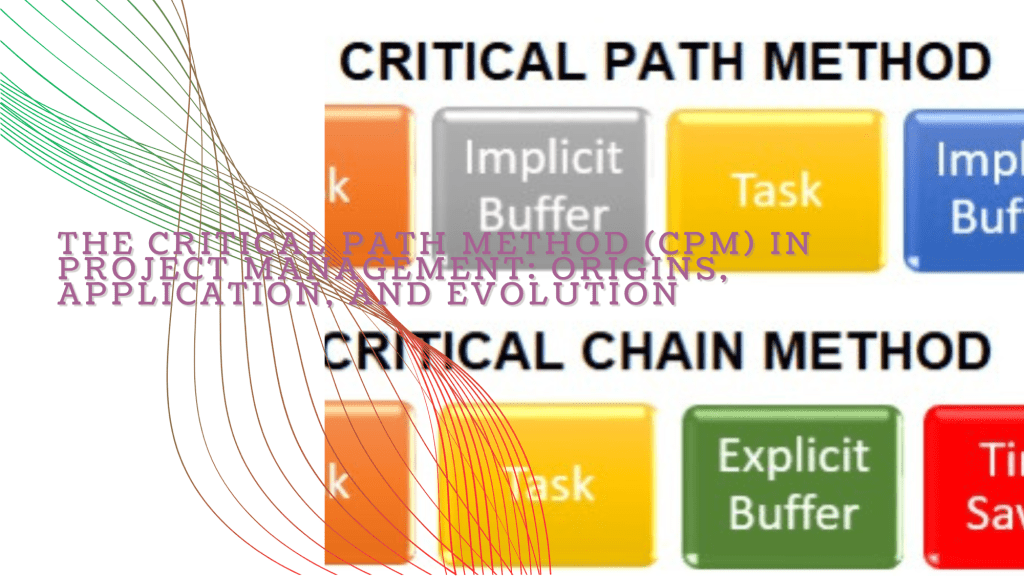
The Critical Chain Method (CCM) was developed by Dr. Eliyahu M. Goldratt in the late 1990s as an enhancement to the Critical Path Method. While CPM focuses on task sequences and durations, CCM incorporates resource constraints and variability, making it more flexible and realistic in dealing with uncertainties.
Key Differences between CPM and CCM:
Resource Constraints: Unlike CPM, CCM takes into account the availability of resources, ensuring that tasks are scheduled based on when resources are actually available, rather than assuming they are always available.
Buffer Management: CCM introduces the concept of buffers—additional time added to account for uncertainties in task durations. These buffers are placed strategically to protect the critical chain (the longest sequence of tasks considering resource constraints) from delays.
Focus on Task Completion: While CPM focuses on starting tasks as early as possible, CCM emphasizes the importance of completing tasks as quickly as possible to avoid cascading delays.
Applying the Critical Chain Method:
- Identify the Critical Chain: Similar to CPM, list all tasks, dependencies, and durations, but also consider resource constraints when identifying the critical chain.
- Add Buffers: Add project buffers at the end of the critical chain and feeding buffers at points where non-critical tasks intersect with the critical chain.
- Monitor Buffer Consumption: Track the use of buffers to identify potential delays before they impact the project’s completion.
- Prioritize Task Completion: Encourage teams to focus on completing tasks quickly, rather than simply starting them early, to minimize delays.
Conclusion
The Critical Path Method and its evolution into the Critical Chain Method are powerful tools in project management, particularly for complex, resource-intensive projects. CPM is best suited for projects where task sequences and dependencies are the primary constraints, such as construction or large-scale engineering projects. On the other hand, CCM is more appropriate for projects where resource constraints and variability are significant concerns, such as in software development or research and development projects.
Tools for Implementing CPM and CCM:
Software: Microsoft Project, Primavera P6, and Smartsheet for CPM; ProChain and Leankit for CCM.
Step-by-Step Guide to Implementing CPM/CCM:
- Define the Project Scope: Clearly define the project’s objectives, deliverables, and constraints.
- Break Down the Project: Decompose the project into manageable tasks.
- Identify Dependencies: Determine the relationships between tasks.
- Estimate Durations and Resources: Assign time estimates and identify resource needs for each task.
- Select the Appropriate Method: Choose between CPM and CCM based on the nature of the project.
- Create the Schedule: Develop the project schedule, identifying the critical path or chain.
- Monitor Progress and Adjust: Continuously monitor the project’s progress, making adjustments to the schedule as needed to keep the project on track.
- Manage Buffers (for CCM): In the case of CCM, carefully manage and monitor buffers to ensure the project remains within its timeline.
By understanding and applying these methods, project managers can significantly enhance their ability to deliver projects on time and within budget, regardless of the complexity and uncertainty involved.
 Sebastian Strobl