
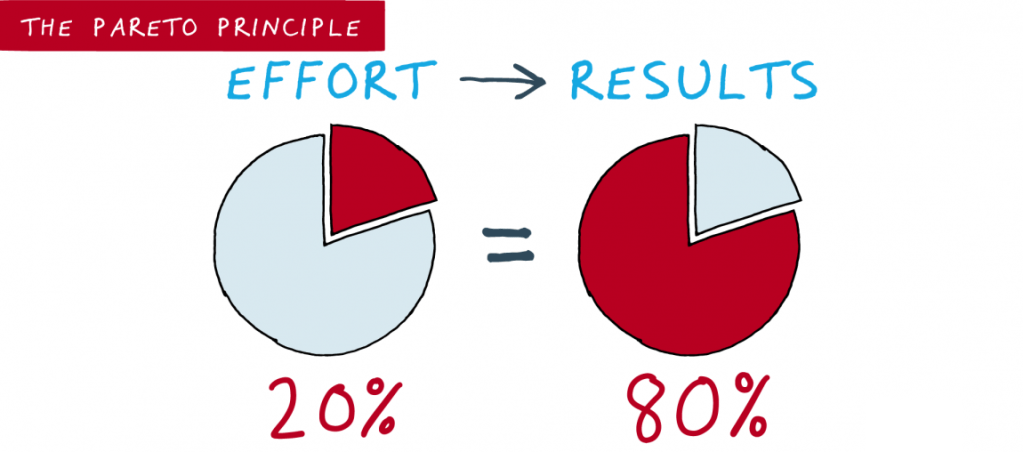
The 80/20 Rule, also known as the Pareto Principle, is a principle that states that approximately 80% of the effects come from 20% of the causes. In other words, a small proportion of causes often leads to a large proportion of the results. This principle was named after the Italian economist Vilfredo Pareto, who observed that 80% of the land in Italy was owned by 20% of the population.
Key Points of the 80/20 Rule
- Inequality of Distribution: The principle highlights that not all inputs or efforts contribute equally to the outcomes.
- Universal Application: The 80/20 rule can be applied across various fields and situations, including business, economics, software development, health, and personal productivity.
- Focus on the Vital Few: By identifying and focusing on the critical 20% that contributes to the majority of the results, one can improve efficiency and effectiveness.
Examples of the 80/20 Rule
- Business: 80% of a company’s profits often come from 20% of its customers.
- Sales: 80% of sales typically come from 20% of products or services.
- Time Management: 80% of productive work is often achieved in 20% of the time.
- Software Development: 80% of software bugs are usually found in 20% of the code.
Practical Implications
- Prioritization: Focus on the key areas that drive the most value or have the highest impact.
- Efficiency: Allocate resources and efforts to the most influential activities.
- Problem-Solving: Identify and address the root causes that lead to the majority of problems or defects.
Summary
In summary, the 80/20 rule is a powerful concept for understanding the disproportionate relationship between causes and effects, allowing individuals and organizations to optimize their efforts and resources for maximum impact.
Implementation in Project Management
Implementing the 80/20 rule in project management can significantly enhance efficiency and effectiveness by focusing on the most impactful activities. Here are some practical ways to apply the 80/20 rule in project management:
1. Prioritizing Tasks
- Identify Critical Tasks: Determine which 20% of tasks will produce 80% of the project’s results.
- Focus Resources: Allocate more resources and time to these critical tasks to ensure they are completed effectively.
2. Resource Allocation
- Key Team Members: Assign the most skilled and experienced team members to the tasks that have the highest impact on the project’s success.
- Budget Allocation: Direct a larger portion of the budget to the activities that drive the most value.
3. Risk Management
- Key Stakeholders: Identify the 20% of stakeholders who have the most influence over the project’s success.
- Engagement Efforts: Prioritize communication and engagement efforts with these key stakeholders to ensure their support and alignment.
5. Time Management
- High-Impact Activities: Concentrate on the 20% of activities that will yield the most significant results.
- Eliminate Wastes: Reduce or eliminate time spent on low-impact activities that do not contribute substantially to the project’s objectives.
6. Quality Management
- Critical Quality Metrics: Identify the 20% of quality metrics that impact 80% of the project’s deliverables.
- Focus on Improvement: Prioritize quality improvement efforts on these critical areas.
7. Performance Monitoring
- Key Performance Indicators (KPIs): Track the 20% of KPIs that provide 80% of the insights into project performance.
- Regular Reviews: Conduct regular reviews focused on these KPIs to ensure the project stays on track.
Practical Steps for Implementation
- Data Analysis: Regularly analyze project data to identify high-impact tasks, risks, and stakeholders.
- Pareto Chart: Use Pareto charts to visually represent the most significant factors affecting the project.
- Continuous Review: Periodically review and adjust priorities based on new information and changing project dynamics.
- Training and Awareness: Train the project team on the 80/20 rule and its benefits to ensure they understand and apply it effectively.
Example
- Identifying: Determining that 20% of the features will provide 80% of the user value.
- Prioritizing: Focusing development efforts on these high-value features first.
- Allocating Resources: Assigning the best developers to these critical features to ensure they are implemented correctly and efficiently.
- Risk Management: Identifying the top 20% of potential bugs that could cause 80% of the system failures and prioritizing their resolution.
By applying the 80/20 rule in project management, project managers can optimize their efforts, enhance productivity, and increase the likelihood of project success.
 Sebastian Strobl