
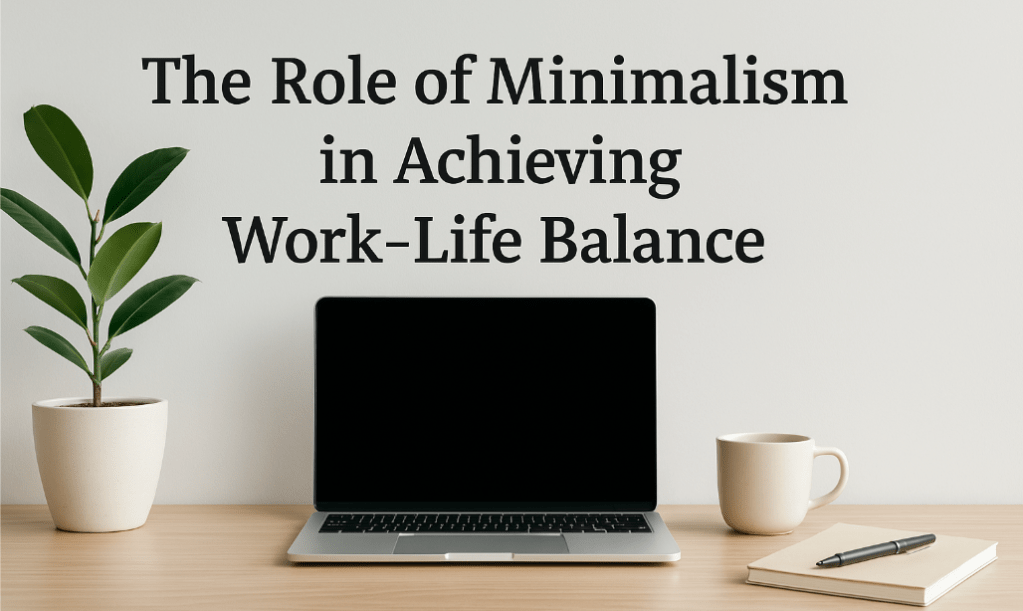
🌀 The Chaos We Call Balance
You wake up, check emails before your feet hit the floor, rush the kids to school, sit through back-to-back Zoom calls, reply to Slack messages over lunch, manage a project milestone, and then, somehow, find yourself answering one last email in bed at 10:47 p.m.
Sound familiar?
For many professionals, balance feels more like juggling chainsaws than walking a tightrope. We add productivity hacks, new calendar apps, and time-saving gadgets—yet our schedules get fuller, our energy thinner, and our patience shorter.
But what if the key to true work-life balance wasn’t more—but less?
Welcome to the power of minimalism.
⚖️ What Work-Life Balance Actually Means
Let’s clear something up: work-life balance isn’t about perfectly dividing your time between your job and personal life. It’s about intentional living—devoting your energy to what truly matters and filtering out the rest.
Balance isn’t a 50/50 split.
It’s:
- Saying no to unnecessary meetings so you can say yes to dinner with your family.
- Logging off when your brain needs rest, not just when your inbox is empty.
- Letting go of “shoulds” in favor of what aligns with your values.
And that’s where minimalism steps in—not as a trend, but as a compass.
🔍 Minimalism: The Productivity Power-Up
Minimalism is often misunderstood. It’s not about owning 10 things or living in a blank white room. It’s about clarity, focus, and removing the excess that clouds your judgment and steals your time.
In a professional context, minimalism means:
- Fewer priorities = Better focus
- Less noise = Better thinking
- Simpler systems = Smoother execution
Research shows we make over 35,000 decisions a day. Every item on your desk, app on your phone, or tab in your browser adds to cognitive load. Minimalism reduces decision fatigue—leaving your mental energy for things that matter.
🧠 Practical Applications at Work
Here’s how minimalism works its magic at the office (or your kitchen table, if you’re working remotely):
1. Declutter Your Calendar
If your calendar looks like a game of Tetris, it’s time for a reset. Cut out recurring meetings that serve no real purpose. Ask: Does this need to happen? Could it be handled asynchronously?
2. Single-Task Like a Pro
Multitasking is a myth. Studies show it reduces productivity by up to 40%. Use time-blocking to focus on one task at a time. Tools like Pomodoro timers or apps like Forest can help you stay locked in.
3. Apply the 80/20 Rule
Chances are, 20% of your efforts yield 80% of your results. Identify high-impact tasks and ruthlessly prioritize them. Let go of the “busy work.”
4. Master Email Minimalism
Inbox zero is overrated. Check email 2-3 times a day—set a timer. Use labels, templates, and filters. Your inbox should work for you, not the other way around.
🏡 Practical Applications at Home
Now let’s bring that clarity into your personal life—where it really matters.
1. Set Tech Boundaries
Just because your phone is nearby doesn’t mean you need to be on-call. Create work shutdown rituals. For example: no emails after 7 p.m. or no screens in the bedroom.
2. Simplify Your Space
Visual clutter leads to mental clutter. Streamline your home setup—less décor, fewer distractions. A clear environment fosters a calm mind.
3. Schedule Nothing
Yes, you read that right. Leave blank space in your week. Time for spontaneity, reflection, even boredom. That’s when creativity—and deep connection—flourish.
4. Be Present, Not Perfect
You don’t need 5 hours of family time every day. You need 10 minutes of undivided attention. Trade quantity for quality. Put the phone away. Play a board game. Ask meaningful questions.
🧭 The Minimalist Mindset: A Mental Shift
Minimalism isn’t just about systems—it’s a philosophy.
From FOMO to JOMO
Let go of the Fear of Missing Out. Embrace the Joy of Missing Out. Say no to things that don’t align. Your energy is a finite resource—spend it wisely.
The Power of “No”
Every “yes” is a “no” to something else. Learn to say no to last-minute meetings, extra responsibilities, and social obligations that drain you.
Self-Reflection is the Anchor
Review your week. What brought you energy? What drained it? Use a minimalist journal to track your focus and adjust course. Minimalism requires regular realignment.
👨👩👧👦 Real-Life Mini Case Studies
Let’s make it real:
- The Project Manager: Trimmed her meeting load by 30%—focused on strategic tasks, and finally had time to coach her team. Result? Less stress, better results.
- The Young Family: Went screen-free after 7 p.m. for one week. Kids slept better, parents connected more. It became their new norm.
- The Entrepreneur: Cleared his workspace, removed 70% of unused apps, and started time-blocking. He called it the most productive month of his career.
These aren’t unicorns. They’re people like you—choosing less, and gaining more.
🎒 Your Minimalist Work-Life Starter Pack
Here’s how to start today:
✅ Declutter Your Digital Life
— Delete unused apps
— Unsubscribe from 10 newsletters
— Use one to-do list app only
✅ Audit Your Calendar
— Eliminate one low-value meeting
— Add a 30-minute “deep work” block daily
— Schedule a 24-hour window with no social plans
✅ Simplify Your Habits
— Create a consistent morning ritual
— Turn off phone notifications
— Keep a “done” list to celebrate progress
Bonus Tools to Try:
- Notion: For streamlined project and task management
- Minimalist: A clean, distraction-free to-do app
- Sunsama: Plan your day with intention
- Forest: Stay focused by planting virtual trees 🌱
✨ Final Thoughts: Simplicity Is Sustainable
Work-life balance isn’t about perfection—it’s about presence. And minimalism helps you get there.
By cutting the excess, you make space for what matters: deep work, meaningful rest, genuine connection, and peace of mind.
Start small. Say no once. Clear one drawer. Remove one app. You’ll be amazed how quickly clarity compounds.
📥 Want a quick win?
Download your free checklist: “10 Minimalist Habits for a Balanced Work-Life”
🗨️ What’s one thing you’ll simplify this week? Drop a comment and let’s inspire each other.



 Sebastian Strobl